
10 Incredible Street Art Murals Worldwide (Part 3)
Ten giant street-art mural stops—Adelaide, Fukushima, Paris, Rennes, Neerpede, Ordes, Buenos Aires, New York, Glasgow, and one unnamed wall—plus how to look at illusion-scale work.
Giant street art murals repay looking twice. Scale alone can stop a walker; illusion, wit, and site-specific color can hold them there. This third roundup gathers ten mural moments tied to cities across several continents—Adelaide, an unnamed wall, Fukushima, Paris, Rennes, Neerpede, Ordes, Buenos Aires, New York, and Glasgow—the kind of work that turns a blank elevation into a temporary landmark until weather, renovation, or a new layer of paint changes the story.
Street photography of murals is half the art’s afterlife. The other half is still the wall: wet cobbles, parked bikes, bus shelters, and people who did not come for a gallery visit and got one anyway.
1. Adelaide, Australia
Adelaide’s street-art culture has long mixed festival commissions with quieter laneway pieces. Large murals there often lean into bright, graphic color against the city’s dry light—faces, animals, and abstract fields that read clearly from a tram or a bike. Illusion-friendly work uses corners and recesses so a painted form seems to lean into the sidewalk or open a false doorway in brick.
What makes Adelaide murals photograph well is contrast: strong sun, pale stone, and sudden saturated pigment. Morning or late afternoon side light deepens trompe-l’oeil shadows that noon flattens. If you chase walls here, give yourself time to walk past once for subject and once for angle; anamorphic pieces forgive almost nothing if you stand in the wrong spot.
The city’s scale helps. Mid-rise walls are tall enough for drama without the canyon wind that shreds scaffolding in denser metros.
2. Location unknown
Some of the best mural photographs arrive without a clean pin on the map. A wall in an industrial belt, a temporary hoarding, a tunnel mouth—places artists choose for surface and privacy more than tourism. “Location unknown” is not a failure of documentation so much as a reminder that street art still includes work made for the few who pass, not for the feed.
Unsigned or lightly tagged illusion pieces often rely on pure craft: matched perspective lines, careful gradients, a single object that appears to pierce the plane. Without a city name, the viewer reads technique first and civic branding second. That order can be clarifying.
When you share or archive such images, note what you can honestly know—date, materials if visible, approximate region—and resist inventing a postcard address the artist never claimed.
3. Fukushima, Japan
Murals in and around Fukushima carry a different weight than festival wallpaper. Large public images there have included hopeful, communal, and commemorative themes alongside purely playful illusion. Scale matters because it gathers people; color matters because it insists on life in places that have known interruption.
Photographers should treat these walls with the same respect owed to any site of memory: no climbing barriers for a better crop, no treating solemn work as backdrop for unrelated poses. Technical craft still applies—wait for even light, include a human figure for scale when appropriate, leave room around lettering so messages stay legible.
Street art in Japan often coexists with strict norms about private property and public order. What appears online as a spontaneous giant may have been a permitted project. Context is part of the frame.
4. Paris, France
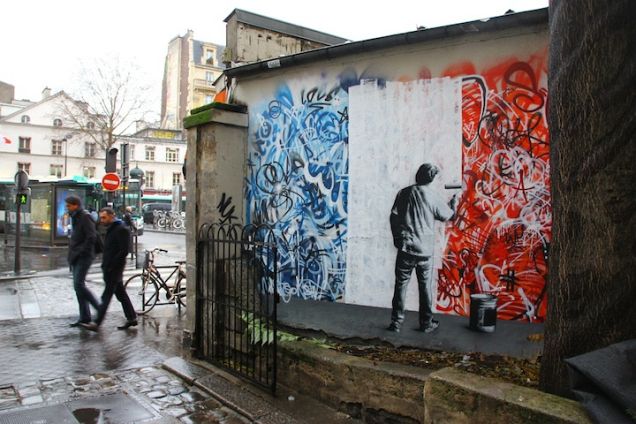
Paris rewards mural hunters who look sideways on wet days. One enduring image from this roundup shows a stencil of a man with a paint roller seeming to brush a clean white stripe between fields of blue and red graffiti tags—together reading as the French tricolor on a pale wall. A stenciled bucket sits at his feet. Cobblestones shine after rain; pedestrians and bicycles continue the city’s ordinary traffic while the wall performs a joke about order, chaos, and national color.
The piece works because it uses graffiti’s own visual language—tags, drips, density—as pigment inside a larger graphic idea. It is meta without being smug: street mark-making becomes the stripes of a flag, and the “painter” is paint himself. Overcast light helps; hard sun would bleach the middle white and crush the wet street reflections that give the photograph atmosphere.
Paris murals vanish and reappear with renovation cycles. Catching one beside a wrought-iron gate and a living tree trunk is luck plus walking. The city teaches that street art is temporary civic furniture, not permanent museum inventory.
5. Rennes, France
Rennes, like other French cities with strong student and arts scenes, has hosted large murals that wrap façades and courtyard walls. Illusion work here often plays with architecture already present—window grids, stone courses, corner turns—so painted depth feels borrowed from the building rather than pasted on.
Breton light can be soft and changeable. That softness favors subtle gradients and pastel trompe-l’oeil; high-contrast stencil pieces still punch through on grey days. Walk residential streets as well as known arts districts; some of the strongest walls sit where laundry lines and bike racks prove the mural is lived with, not only visited.
Pair Rennes with Paris in a France itinerary and you see two tempos: capital spectacle versus regional wall culture that still surprises around a corner.
6. Neerpede, Belgium
Neerpede sits in the Brussels orbit, where canal edges, park margins, and quieter roads offer walls less contested than the densest tourist cores. Belgian street art has long mixed comic figuration, political bite, and precise lettering. Giant pieces in greener or peripheral settings gain a different kind of drama: mural scale against trees, sky, and open space instead of against a canyon of glass.
Illusion murals in such settings can use real landscape as continuation—painted grass meeting actual grass, painted water suggesting a path into the park. Photographers should include enough environment to show that dialogue; a tight crop that deletes the trees deletes half the idea.
Belgium’s weather will test outdoor paint. Freshness in a photograph may mark a narrow window after completion and before the next season’s wear.
7. Ordes, Spain
Ordes, in Galicia, is a smaller stage than Madrid or Barcelona, which is exactly why a giant mural there can redefine a whole street. In towns of this scale, a single commissioned wall becomes local identity overnight: meeting point, postcard, and argument about taste all at once.
Spanish mural festivals and local projects have pushed hyperreal faces, folkloric motifs, and bold geometric skins across Iberian walls. Illusion pieces may open false arches into painted countryside or make a flat gable read as deep space. Side light on pale Galician stone intensifies edges; mist softens them into dream logic.
When a mural carries a town’s name in conversation, document the surrounding shops and sidewalks. Context keeps “incredible photo” from becoming a floating texture with no place attached.
8. Buenos Aires, Argentina
Buenos Aires is one of the world’s great mural cities—block-long paintings in Palermo, La Boca color, political memory on corner walls, and a constant negotiation between commissioned work and unsanctioned layers. Giant figurative murals here often stare back at traffic with a directness that feels conversational rather than decorative.
Illusion and 3D-leaning pieces compete with an already maximal visual field: fileteado echoes, hand-lettered signs, football murals, and dense graffiti. Standing farther back helps. So does returning at different hours; late light rakes across relief-like paint and reveals how much texture a “flat” wall actually holds.
Ask before photographing people in front of sensitive memorial murals. The city’s walls include grief and pride; tourism manners matter.
9. New York, USA
New York’s mural map shifts by neighborhood and by year: legal walls, rolled permission pieces, warehouse sides in Brooklyn and Queens, and the perpetual overwrite of the city’s visual noise. Giant works here fight billboards and scaffolding for attention. The ones that win usually own a full elevation with a single clear idea—portrait, abstract field, or a perspectival trick that photographs cleanly from across the street.
Illusion murals in New York often play with the city’s own verticality: fake elevators, false fire escapes, painted voids that seem to cut the building open. Include a yellow cab, a bike courier, or a fire hydrant if they appear naturally; scale references turn paint into place.
Access changes fast. A wall famous last spring may be grey primer by autumn. Shoot when you see it.
10. Glasgow, Scotland
Glasgow’s mural trail and independent walls have turned parts of the city into an outdoor collection—literary figures, local heroes, surreal animals, and bold graphic statements against sandstone and modern infill. Rain is a collaborator: wet streets double colors, and overcast skies keep highlights from blowing out on pale paint.
Large Scottish murals often feel conversational with pedestrians because many sit at street level along ordinary errands routes. Illusion pieces that “break” the pavement or open a painted alley reward the slow walker more than the tour-bus window. Bring a hood and patience; the best frames may arrive between showers when umbrellas close and the cobbles still shine.
Glasgow proves again that mural culture thrives where cities invest in walls as public surface, not only as real-estate blankness.
How to look at giant walls
Walk the full width before you lift a camera. Find the artist’s intended viewpoint if the piece is anamorphic. Include a slice of real city—signage, weather, a passerby—so the mural stays street art instead of floating illustration. Credit artists when signatures or known commissions make that possible; leave “unknown” honest when it is.
These ten stops—from Adelaide’s bright façades to Glasgow’s rain-fed color, with Paris’s tricolor painter as a visible reminder of how witty a wall can be—sketch a world map of mural ambition. The next incredible photograph is probably already drying somewhere you have not booked a ticket for yet. Keep walking city edges. The giant work is counting on someone to look up.

Comments
Continue reading
15 More Incredible Street Art Photos Worldwide
Part two: giant murals from Philadelphia, Lyon, Warsaw, Lisbon, Vienna, New York, Dublin, Berlin, and beyond—plus a few still-unlabeled walls.
15 Incredible Street Art Photos from Around the World
Part one of a mural roundup—giant street art photographed in Norway, Spain, Poland, the US, Russia, the UK, and Denmark.
Oakoak’s Playful Urban Street Interventions
French street artist Oakoak turns cracks, hydrants, and overlooked fixtures into small site-specific jokes—minimal marks, pop-culture wit, and ephemeral city play.