
Alessandro Diddi’s Anamorphic 3D Drawings: Hands, Folds, and False Depth
Italian artist Alessandro Diddi folds paper, locks a camera angle, and drafts shadows until claws, bridges, and bitten fingers seem to leave the page.
Anamorphic 3D drawings have become a familiar internet genre: folded paper, a carefully chosen camera angle, and graphite that pretends to stand up. Italian artist Alessandro Diddi belongs to that circle, yet his work stays distinct because of how aggressively he stages collaboration between the page and the physical world. Pencils, rings, erasers, and his own hands are not props after the fact. They are co-actors. Angles and shades are drawn so the sketch seems ready to leave the sheet—and sometimes ready to bite, pull, or push back.
“I want my drawings to put across the message that the eye can trick the mind and make you believe that there are dimensions that are not really there.” – Alessandro Diddi
That statement is less a slogan than a working brief. Diddi builds belief by controlling viewpoint, cast shadow, and the seam where graphite meets real flesh or wood. The gallery below follows that brief through clawed transformations, geometric towers, floating snakes, tug-of-war figures, and stone architecture that occupies a paper corner as if it had always been a room.
Hand to claw: the fold as a portal
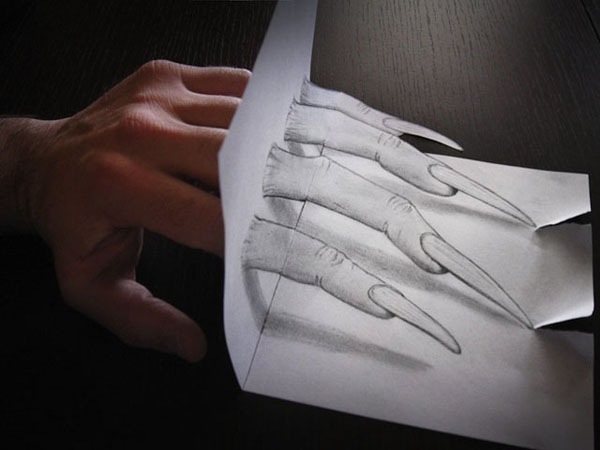
On a dark wooden surface, white paper stands at a right angle. A living hand slides behind the vertical plane; on the far side, three elongated, skeletal fingers finish the gesture with needle claws. The fold becomes a threshold. What enters as human exits as something else. Shadows drawn under the claws align with the room’s light so the graphite digits seem to hover toward the lens. The trick is not only perspective. It is narrative compression: metamorphosis staged in the width of a crease.
Pinching a tower of solids
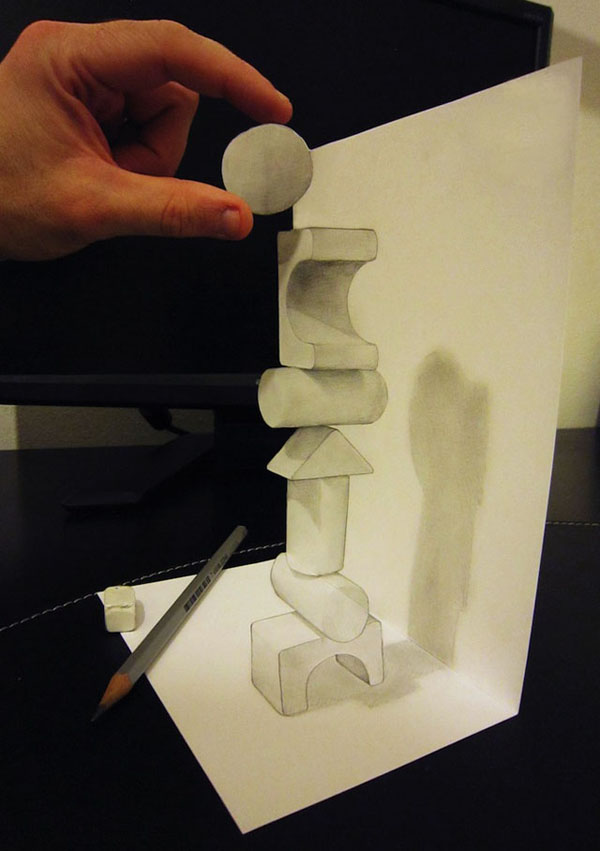
Here the fold supports a stack of geometric volumes—arched block, cylinders, prism, concave form—rising like a precarious toy. A real hand pinches the top cylinder. Pencil and eraser wait on the desk, reminders of ordinary tools. A long false shadow climbs the vertical sheet, mimicking a wall behind a solid tower. Anamorphosis does the hidden work: shapes distorted across two planes snap into one object only from this camera station. Diddi’s humor sits in the pinch. If the tower is “real” enough to hold, the mind accepts mass; once mass is accepted, the rest of the lie rides free.
Palm, ring, and borrowed space
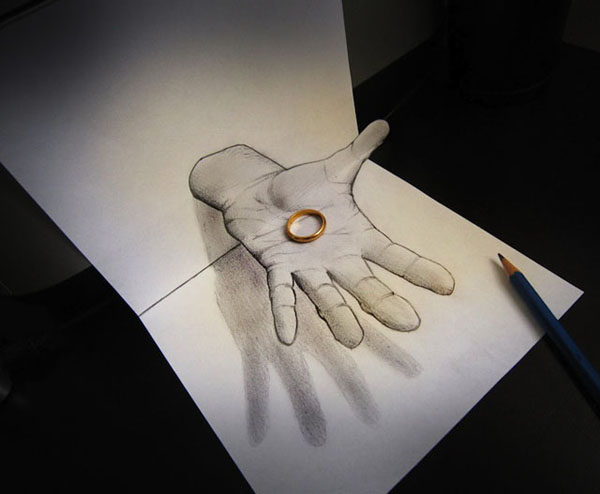
A left hand opens across the corner of folded paper, palm up, a small gold ring resting in its center. Wrist and base occupy the vertical plane; fingers travel the horizontal. Soft shadows under the digits invent lift. Most of the drawing stays in graphite, so the ring’s warm metallic note reads as a foreign object that somehow belongs—another Diddi tactic: one modest color accent that makes the grayscale flesh feel more photographic. A blue pencil beside the sheet supplies scale and a quiet punchline. The instrument that made the hand now sits smaller than the hand it drew.
Snake that refuses the flat
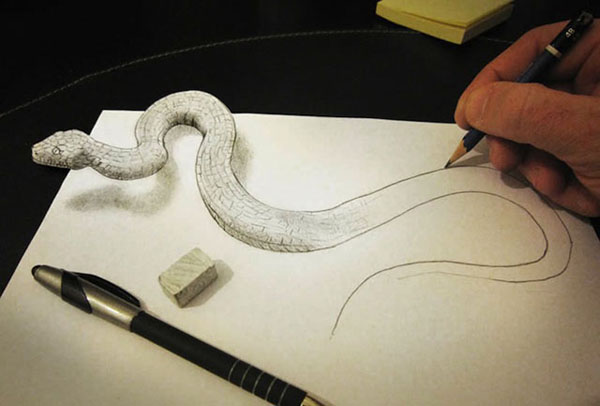
Not every piece needs a hard fold. On a single sheet, a coiled snake rises in an S-curve: head and forward body shaded as if airborne, gridlike scales catching soft light, while the tail collapses back into ordinary line where a real 4B pencil is still finishing it. Eraser and pen share the page like studio debris. The transition from floating mass to flat contour is the lesson. Illusion is local. Diddi can turn it on and off within inches, which makes the floating section feel less like a filter and more like a temporary physics exception.
Tiny figures versus a real pencil
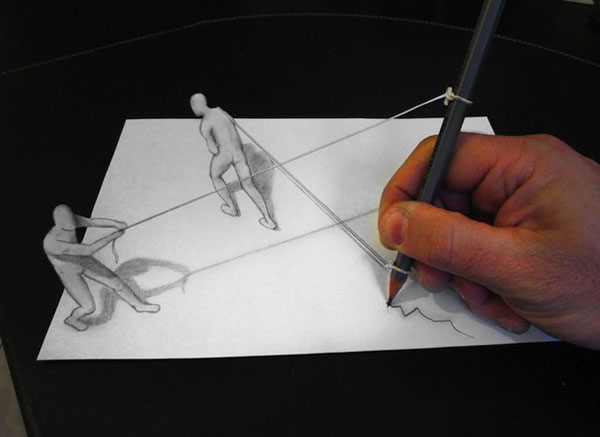
Two featureless gray figures lean back in a tug-of-war, ropes (or lines) lashed to a real pencil held by a living hand. One figure crouches and pulls low; the other braces farther back. Shadows pool behind each body so they read as standing above the paper rather than stained into it. A jagged “crack” at the pencil tip suggests the struggle has already marked the sheet. The comedy is scale: graphite people fighting their maker’s tool. The craft is still anamorphosis and cast shade, but the subject is authorship. Who controls the line when the line grows arms?
Pushing the paper wall
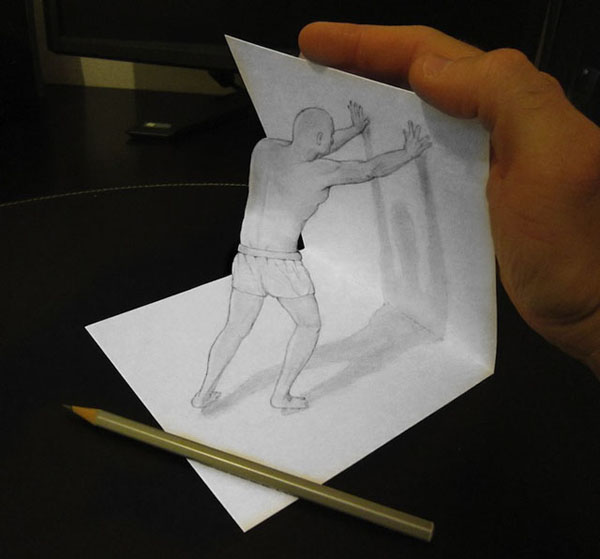
A bald, muscular figure in light shorts braces against the vertical face of folded paper, feet planted on the horizontal “floor.” A real hand holds the upright sheet open at ninety degrees. Drawn shadows on wall and floor sell pressure and weight; a wooden pencil rests in the lower corner like a discarded crowbar. The pose is pure theater—someone trying to shove open a room that is only stationery. Yet the anatomy holds under scrutiny: tendons, shortened perspective on the limbs, contact darkness where palms meet the vertical plane. Diddi’s illusions rarely rely on vagueness. They survive zooming in.
Mouth, finger, and a drop of red
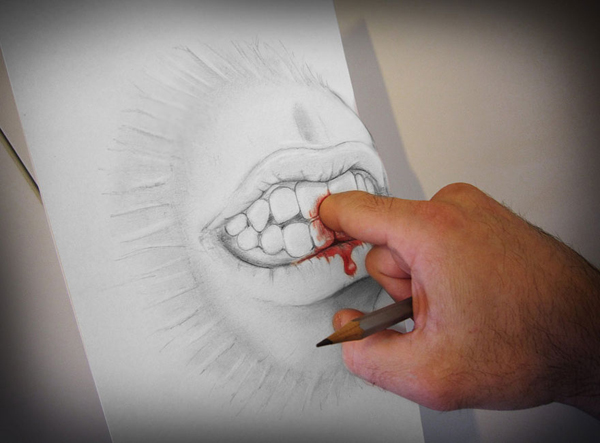
Horror-comedy enters with an open mouth—teeth, lips, a fuzzy surround—rising from the page while a real index finger sits between the drawn jaws. A vivid red mark and a drip below break the monochrome spell. The finger belongs to a hand that also holds a pencil, collapsing maker and victim into one gesture. Anamorphosis lifts the mouth; the blood sells consequence. Viewers flinch before they analyze, which is exactly when illusion art wins. Analysis can come second. The first job is to make the nervous system vote “yes.”
Stone bridge as pop-up architecture
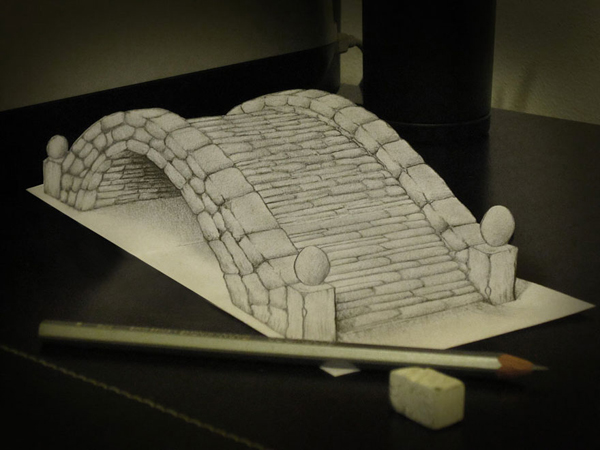
Not all of Diddi’s subjects are bodies. A single-arch stone bridge, masonry carefully hatched, spherical finials on corner posts, spans the white rectangle so that from a low angle it appears to rise as a miniature structure. Silver pencil and white eraser in the foreground calibrate size. Deep shade under the arch and along the far flank invent thickness; a paper-cast shadow invents height. Without a fold, the piece still behaves like a model kit assembled by light alone. Architecture on a desk is a different persuasion from claws and snakes: quieter, more patient, just as ruthless about viewpoint.
Stairs to a drawn door
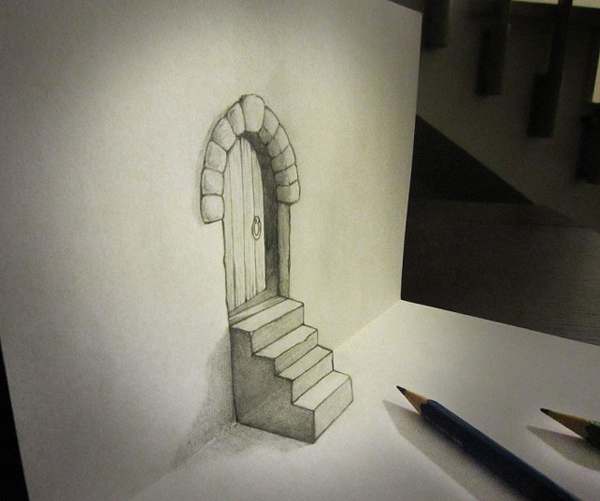
Two sheets again form a corner. Four stone steps climb the horizontal plane toward an arched wooden door on the vertical one—ring handle, plank grain, rounded block surround. Shadows fall left of the stairs and into the arch, implying light from the upper right. Pencils rest on the lower sheet as reality checks. The staircase “pops” at the join where floor becomes wall, a favorite Diddi theater. You are invited to imagine walking up—knowing you cannot—because the risers read as climbable volumes. Desire to enter is another form of belief.
How the technique actually works
Across these pieces, a shared toolkit appears. First, choose a camera angle and treat it as sacred; the drawing is engineered for that eye, not for every wander around the desk. Second, invent cast shadows that match a single light direction, including soft penumbra. Third, use real objects—hands, pencils, rings—as measurement sticks that force the brain to reconcile scales. Fourth, exploit paper geometry: a ninety-degree fold supplies an instant floor-and-wall set without carpentry. Fifth, allow transitions; let part of a form go flat so the lifted part feels earned.
Anamorphosis is the mathematical cousin of street-pavement art. Distortion on the plane corrects in the photograph. Diddi’s public images are therefore half drawing and half staging. Lighting, desk texture, and the precise placement of a living finger are as authored as the hatching on a stone. That is why his quote about dimensions “that are not really there” lands cleanly. He is not claiming mystical powers. He is describing a contract with optics.
Compared with pure photoreal still lifes that imitate a single object on a flat sheet, Diddi’s illusions emphasize interaction. The page is a stage where graphite can threaten, labor, or architecture itself. Viewers remember the clawed hand and the bitten finger not only because they look dimensional, but because they imply cause and effect. Something happened—or is happening—between ink and skin.
Why these drawings keep circulating
Feeds reward demonstrations. Diddi’s work arrives pre-demonstrated: tools in frame, hands in frame, folds held open. You do not need a caption to understand the dare. Look, compare, doubt, look again. That loop is shareable. It is also teachable. Students can steal the method—fold, light, shadow, camera lock—without stealing the jokes. The jokes remain his: metamorphosis at a crease, tiny rebels against a pencil, a mouth that claims a finger, a door that almost opens onto nowhere.
Spend another minute with any one image and ignore the “wow” for a beat. Track only where the darkest graphite sits, and whether that darkness behaves like contact, cavity, or cast shade. Then notice where a real object interrupts the white field. Those interruptions are anchors. Alessandro Diddi’s art is less about denying the page than about recruiting everything around it—desk, hand, tool, fold—until the mind briefly runs out of excuses and accepts a dimension that paper never had.

Comments
Continue reading
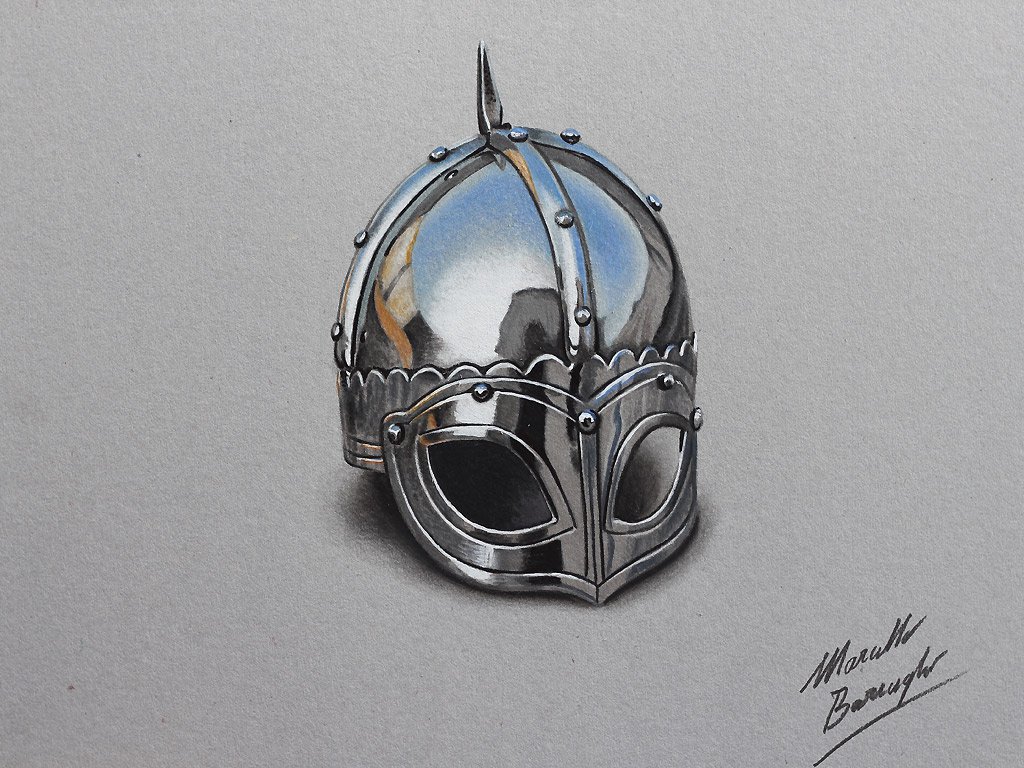
Marcello Barenghi’s Hyperreal 3D Drawings: Chrome, Shadow, and Belief
Italian artist Marcello Barenghi turns flat paper into convincing objects—here, a polished spectacle helmet whose reflections and cast shadow sell true weight.
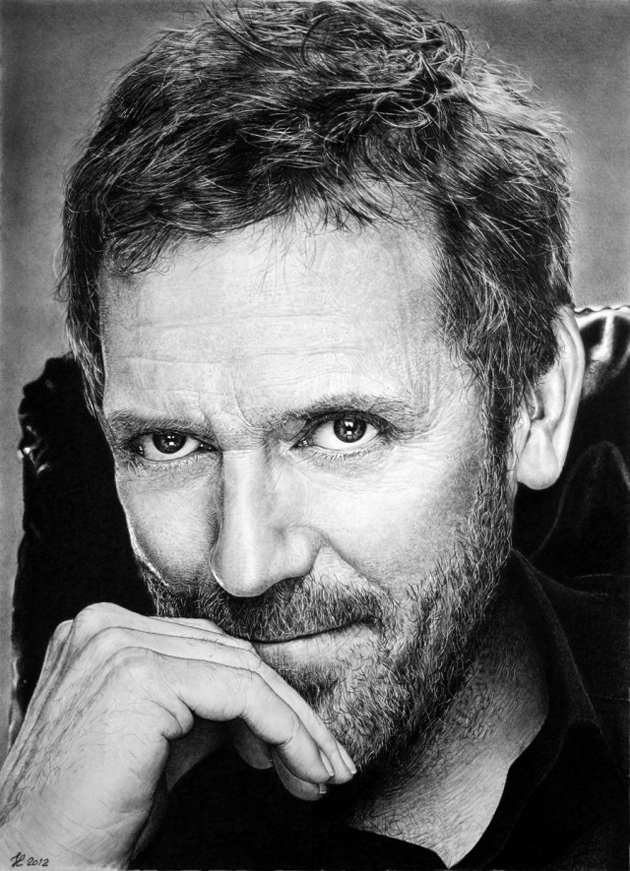
10 Photorealistic Pencil Drawings by Franco Clun
Ten photorealistic graphite portraits attributed to Italian artist Franco Clun—celebrity likenesses, reflections in glasses, a macro eye, and unflinching studies of age.
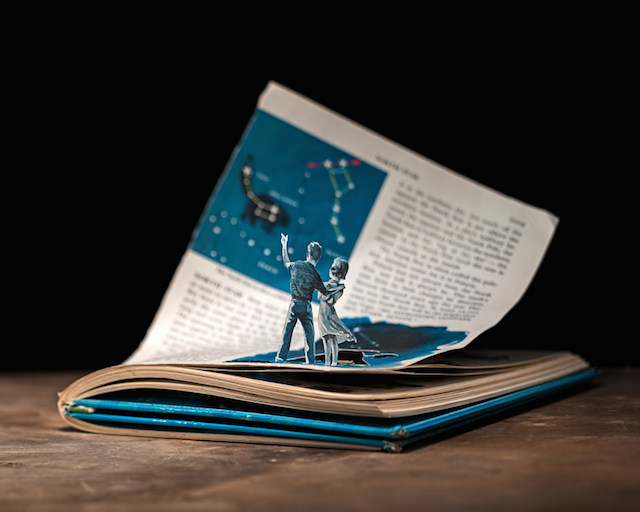
Thomas Allen’s Book-Cut Illustrations
Michigan illustrator Thomas Allen cuts pulp paperback figures into 3D tableaux, photographs them in shallow focus, and gathers the practice in his Aperture book Uncovered.