
Oru Burus: Supinfocom’s Little King Who Lost the Sun
Anton Brand, Guillaume Klein, Charlotte Quillet, and Raphaël Théolade’s dialogue-free 2012 graduation short turns a tiny monarch’s fight with the sun into cosmic comedy.
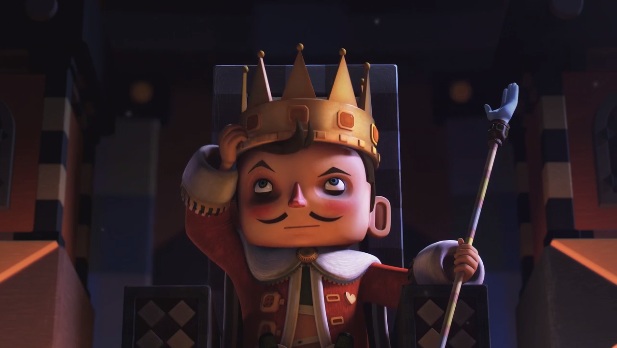
Somewhere between the clouds and the stars, a little king discovers that ruling the sky is not the same as owning it. That is the premise of Oru Burus, a 2012 French 3D animated short and Supinfocom graduation film co-directed by Anton Brand, Guillaume Klein, Charlotte Quillet, and Raphaël Théolade. The story is almost a proverb: once upon a time there was a little king who lost control of the sun—and tried, with escalating stubbornness, to take it back.
At roughly five and a half minutes, with no dialogue, the film has to communicate through silhouette, timing, and world design. Unifrance lists it as a French short in the comedy/bizarre lane, themed as parable and dream. That catalog language fits. Oru Burus is not a naturalistic drama about weather. It is a cosmic workplace farce in which the sun behaves like a living prop that refuses to stay on schedule, and the king behaves like a manager who cannot accept that some systems are larger than his throne.
A four-person graduation machine
Supinfocom (now part of the broader Rubika / Supinfocom tradition of French animation schools) has long been a factory for shorts that circulate festival circuits and online showreels. Graduation films from that pipeline often share a useful constraint: limited runtime, shared credits, and a hunger to prove that students can finish a watchable world. Klein’s own notes describe the project as his Supinfocom graduation movie, with himself as project leader covering artistic direction and animation, plus 3D modeling and set dressing, alongside Brand, Quillet, and Théolade. Brand is also credited as editor on Unifrance’s technical sheet. The collaboration reads as a complete miniature studio: direction, art, animation, and cut shared among a small crew rather than farmed out as isolated homework.
That structure matters for how the short feels. Student films sometimes look like portfolios stitched together—one character model, one lighting pass, one gag. Oru Burus aims for a single fairy-tale atmosphere. The sky is not a background plate; it is the stage. The king is not a mascot; he is a comic tragic figure whose authority depends on a star he cannot leash. When four directors share credit on a five-minute film, the risk is stylistic whiplash. The reward, when it works, is a denser production polish than one person could finish alone under school deadlines.
Power, scale, and a sun that will not obey
The narrative engine is simple enough to explain to a child and sharp enough to survive adult viewing. A little king loses control of the sun. He tries to regain power over it. Everything else—chase, ritual, gadget, tantrum—is variation on that sentence. In fairy tales, kings often claim dominion over seasons, harvests, or the hours of the day. Animation can literalize that claim. Put a small monarch next to a blazing disk and the joke becomes architectural: the crown is tiny; the light is not.
Dialogue would only shrink the joke. Without speech, the film leans on pantomime and visual causality. You read intention in posture and defeat in timing. Comedy of power works best when the audience understands the rules faster than the character does. We already know the sun will not stay put because a human stamped a decree. The pleasure is watching the king invent new methods of insistence—royal versions of the same failed plan—while the cosmos keeps its own physics.
There is also a gentle cruelty in the scale. Call him a “little king” and you have already framed the tragedy as adorable. The short exploits that: authority dressed as childhood scale, cosmic stakes dressed as toy theater. It is closer to a parable than to a character study. You are not asked to psychologize the monarch’s childhood. You are asked to recognize the familiar human habit of treating uncontrollable forces as personal insults.
Look, sound, and the dream logic of school 3D
Technically, the film sits in the early-2010s wave of student 3D that chased soft lighting, readable shapes, and storybook color rather than photoreal grit. Unifrance lists HD, color, 16:9, stereo, and a production year of 2012. Those are the facts. What audiences remember is the floating world: somewhere between clouds and stars, a place where royal furniture and solar mechanics can share the same frame without needing a documentary excuse.
Dream logic is useful here. In a dream, you can lose the sun the way you lose keys. In a dream, reclaiming it can involve ceremonies that would look absurd in daylight. Oru Burus uses that permission. The bizarre comedy Unifrance flags is not random weirdness; it is the weirdness of absolute power meeting absolute indifference. The sun does not negotiate. That indifference is the punchline and the theme.
Set dressing—something Klein specifically claims—often decides whether a short feels inhabited. A throne room, a sky platform, a mechanical attempt to catch daylight: each prop has to telegraph function instantly because there is no exposition. Good student films treat props as verbs. Bad ones treat them as decoration. Oru Burus belongs with the former when the king’s tools read as desperate inventions rather than pretty models parked for a turntable render.
Why the short still travels
Cartoon Brew and festival aggregators such as FAAF helped the film travel beyond the school screening room. Online picks of the early 2010s often favored dialogue-free shorts with one clear image you could describe in a sentence. “Little king who lost the sun” is that kind of sentence. It is shareable without spoiling the gags, and it promises a complete miniature myth rather than a fragment of a larger franchise.
There is also a durable audience for animation about failed control. From classic cartoons of characters fighting the weather to contemporary shorts about bureaucracy and machines, the pattern repeats: a person insists; the world refuses; the refusal becomes funny, then slightly sad, then funny again. Oru Burus joins that lineage with a royal costume. The crown does not make the failure less familiar. It makes the failure more theatrical.
For animators, the takeaway is structural rather than stylistic. One desire (regain the sun). One obstacle (the sun’s independence). One setting elastic enough for escalation. No dialogue tax. Enough production design to make each attempt feel like a new chapter rather than a loop. Graduation films that obey those rules age better than films that try to prove every software skill in six minutes.
Watching it as craft, not only as fairy tale
On a first viewing, follow the king’s plan like a heist gone wrong: goal, method, collapse, revision. On a second viewing, watch how the editors—Brand among them—cut for comic clarity. How long does a failure hold before the next idea arrives? Where does the camera treat the sun as a character rather than a lamp? When does the king’s body acting sell panic versus pride?
Also notice what the film refuses to do. It does not explain the mythology of this sky kingdom. It does not moralize with a closing speech. It does not dilute the parable into a feature-length origin story. The short trusts that “lost control of the sun” is enough premise for five minutes of invention. That trust is a craft decision. Many student projects over-explain because they fear being misunderstood. Oru Burus risks being read as a simple fable—and gains force by staying one.
If you collect French school shorts from the Supinfocom era, file this one under cosmic comedy rather than under technical demo. The modeling and lighting matter, but they serve a clearer joke about scale. A little king wants the day to obey. The day declines. Between those two sentences, Brand, Klein, Quillet, and Théolade built a floating stage where power looks briefly absolute and then, inevitably, ridiculous under the light it cannot command.

Comments
Continue reading
Still-Life Photography by Margareth Perfoncio
São Paulo photographer Margareth Perfoncio’s still lifes of food and flowers—Old Master light, dark wood, and tables that feel inevitable.
Meaningful Love Quotes for Inspiration (and Ink)
Meaningful love quotes that still feel true — short lines for tattoos, gifts, and everyday reminders, with placement and wording tips.
Christina Hess’s Animals From History: Costumed Pets as Playful Portraits
Illustrator Christina Hess reimagines historical icons as ornate animal portraits—Elvis Petme and friends—mixing puns, costume detail, and soft history lessons.