
Extraordinary Bookshelf Designs: From Stair Libraries to Color Wheels
A design-minded gallery of extraordinary bookshelves—double-height rooms, stair-integrated stacks, secret doors, civic mini-libraries—with criteria for judging which ideas are sculpture and which you could live with.
A bookshelf can be a box for paper, or it can be a composition that organizes a room. Jonathan Adler’s reminder still cuts through catalogue noise: treat the shelf as something vital and integrated, not a neutral warehouse. The designs gathered here take that idea seriously. Some are architectural libraries; some are jokes that still hold books; some turn circulation—stairs, doors, windows—into storage. What they share is intention. Books are allowed to be structure, color, texture, and even furniture in their own right.
Before the gallery, a few criteria help separate a clever photo from a design you would actually want to live with.
Criteria for an extraordinary bookshelf
- Clarity of idea. Can you name the concept in one sentence—wall of books in a shop window, stair-as-library, color wheel, secret door?
- Relationship to architecture. Does the shelf fight the room, or does it complete a wall, stair, corridor, or niche?
- Access versus display. Are books reachable without a performance, or is the piece primarily sculpture that happens to include spines?
- Load and safety. Heavy paper needs real structure. Beautiful failure is still failure.
- Editing. Extraordinary shelves look curated even when packed. Random overflow usually reads as clutter, not abundance.
- Light. Spines need illumination. Daylight, pendants, or a tucked lamp often decide whether a library feels alive or cave-like.
Use those tests as you move through the images. Not every piece scores equally on function—and that is fine, if the trade-off is honest.
Books as facade
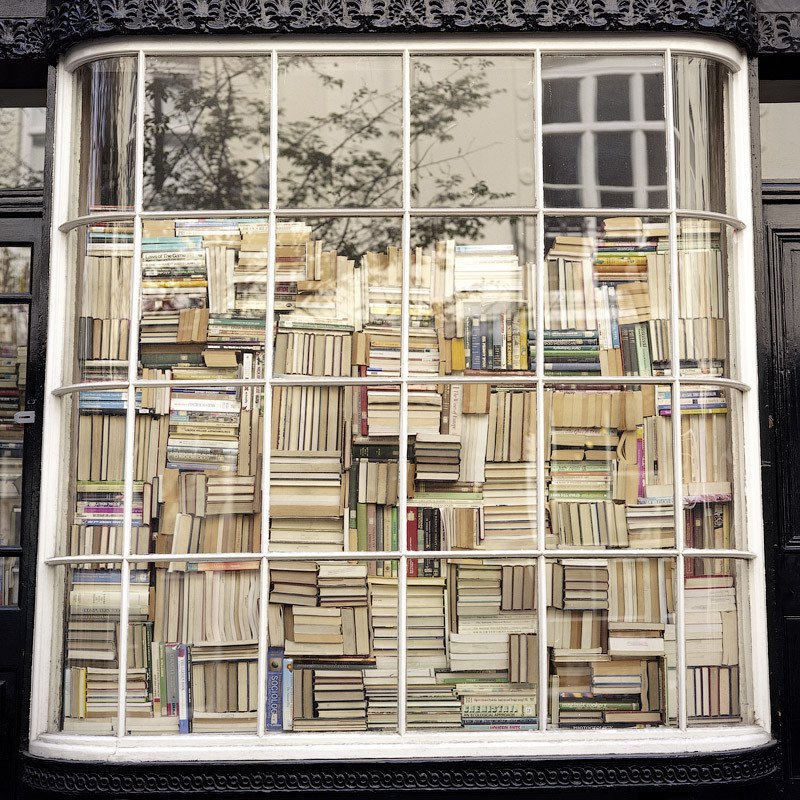
The bow-front shop window stuffed floor-to-ceiling with volumes is less a bookcase than a proclamation. Spines and fore-edges fill every pane until glass becomes a mosaic of paper. Horizontal stacks interrupt vertical rows; cream pages face outward beside colored cloth. Reflections of trees and facing buildings float over the densest sections, so the street and the collection occupy the same plane. As design, it argues that books can be cladding. As commerce or culture, it turns inventory into architecture. You would not “use” this the way you use a bedside shelf—but you understand the room’s priorities instantly.
Double-height rooms that earn the spiral
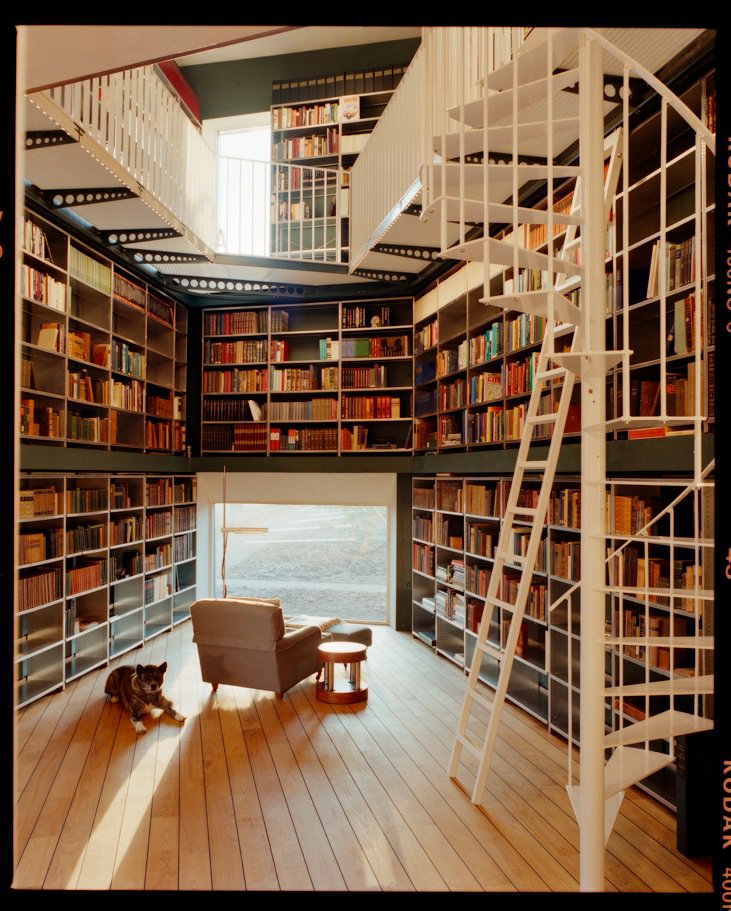
Two interiors answer Adler’s “integrated” brief with volume. In the first, shelves wrap a mezzanine; a white spiral stair unlocks the upper ranks; a low gray lounge chair faces a wide window while a dog claims the wood floor. The grid of shelves is dense but calm—thin verticals, darker horizontals, thousands of spines as wallpaper with purpose. Light from the far window keeps the reading zone from feeling entombed.
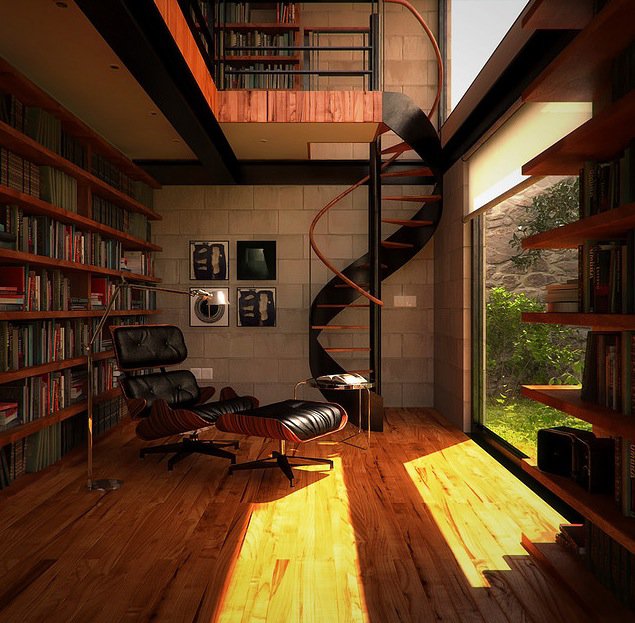
The second library trades white metal for black spiral and concrete-block walls. Built-in wood shelves climb both levels; an iconic lounge chair and ottoman sit in a patch of sun. Here the bookshelf is not a freestanding object you buy after the architecture is finished. It is the architecture’s soft lining. Criteria score: high on access (stair), high on light, high on integration. The extraordinary move is simply refusing to leave vertical air unused.
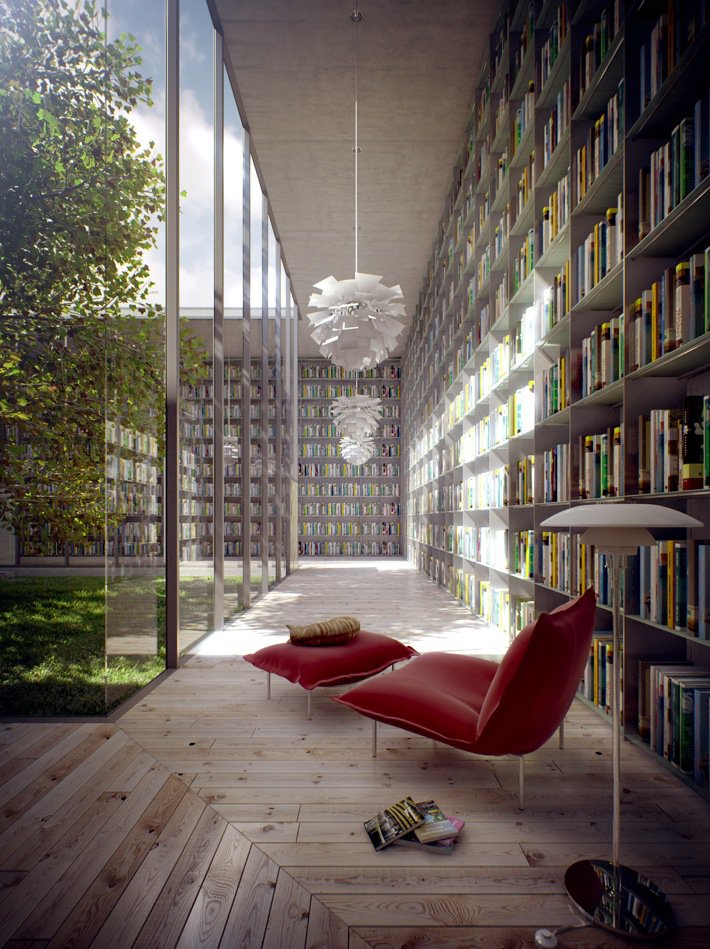
A third full-height example stretches a corridor into a gallery of spines opposite a garden wall of glass. Thin shelving grids run the length and end of the space; red lounge seating and tiered pendants mark a pause for reading. Reflection doubles the books in the glass, so the collection seems to float outdoors. This is the dream-library brief executed with restraint: one material language, one job for the long wall, furniture that does not compete with the shelves.
Humor, civic scale, and color as system
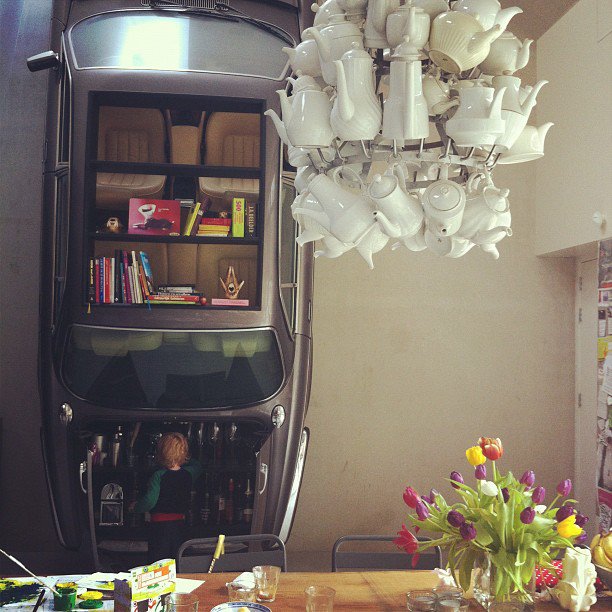
Not every extraordinary shelf is solemn. A vintage city car mounted nose-down becomes a vertical cabinet: cabin turned into shelves, hood opened as a lower cupboard a child can reach. Beside it, a chandelier of white teapots underlines the room’s appetite for repurposing. Functionally, capacity is limited; conceptually, the piece wins by making storage a conversation. Judge it as sculpture-with-books, not as a replacement for a wall of IKEA Billys.
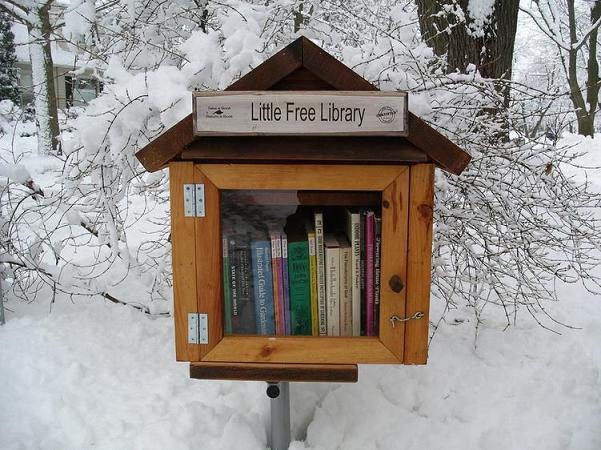
At the opposite end of scale sits a Little Free Library on a post in snow—a gabled wooden box with a glass door and a simple latch. “Take a book, return a book” turns the bookshelf into civic furniture. Weatherproofing, visibility from the sidewalk, and a roof that sheds snow matter more than designer pedigree. Extraordinary here means social design: a shelf that belongs to a street.
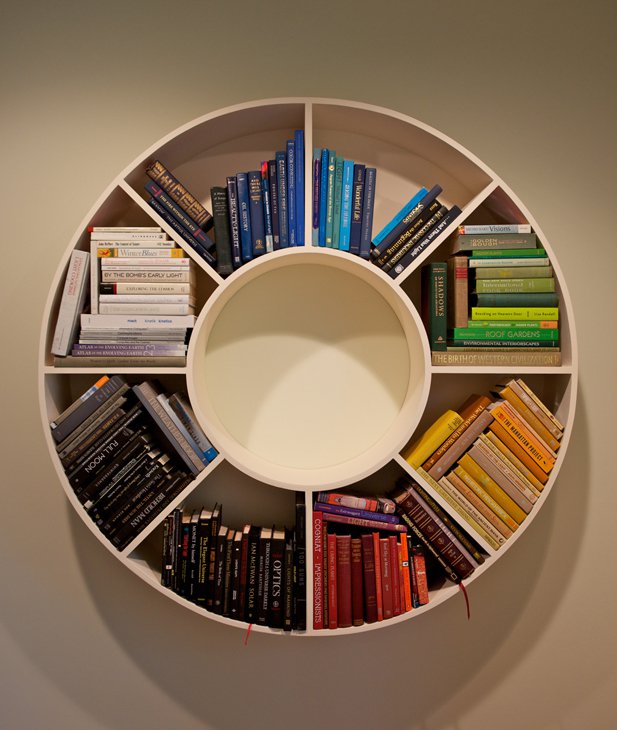
The circular wall unit with eight wedge compartments around an empty hub is pure composition. Books are sorted by spine color into a wheel—whites, blues, greens, warm golds, reds, blacks. Finding a title by subject becomes harder; finding harmony becomes easy. If your criterion is retrieval speed, this fails. If your criterion is turning a blank wall into a color-field painting you can rearrange, it succeeds. Extraordinary shelves often force that trade.
Domestic inventions and illusions
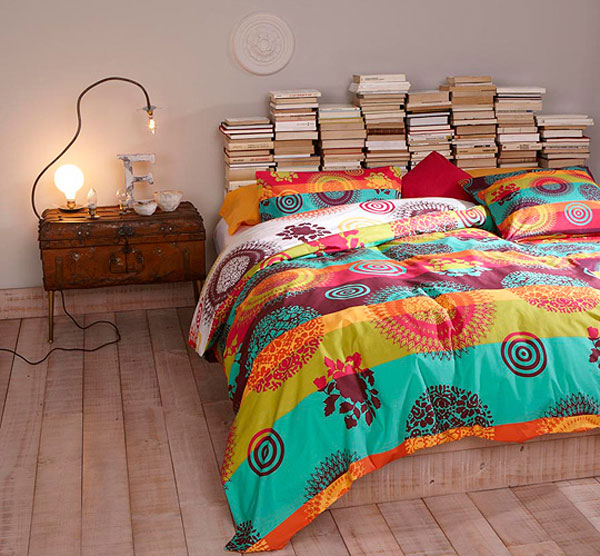
Vertical stacks of aged hardcovers standing in for a headboard turn sleeping into a negotiation with literature. The staggered tops create a soft skyline behind patterned bedding. Practical notes apply: secure stacks against knocks, keep weight away from tipping, and accept that this “shelf” is more backdrop than browsing system. Still, as bedroom composition, it beats a blank wall.
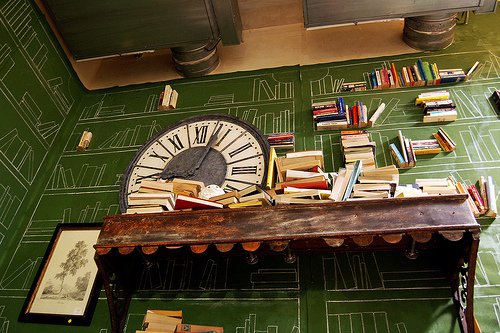
The deep-green room with white line drawings of shelves, interrupted by real books, a mantel pile, and a large clock, plays trompe-l’oeil games. Drawn volumes multiply the collection; physical books puncture the fiction. It is installation thinking applied to interiors—useful if you want atmosphere without square meters of real shelving, risky if you need actual capacity.
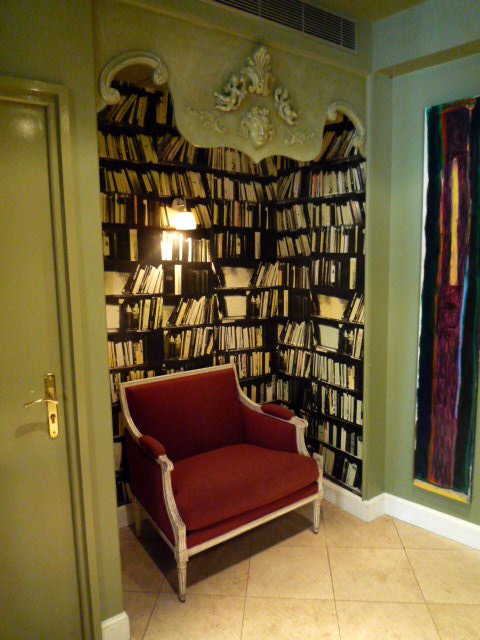
A corner alcove packed tight with dark spines, crowned by ornate molding and faced with a ruby armchair, shows how a small footprint can still feel like a library. Whether the depth is fully functional or partly graphic, the lesson holds: frame the books, give them a chair, and a leftover corner becomes a destination.
When the shelf is the stair
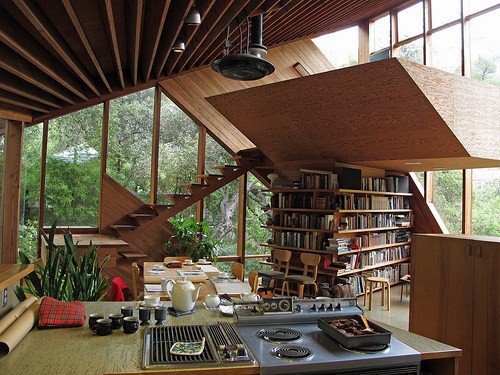
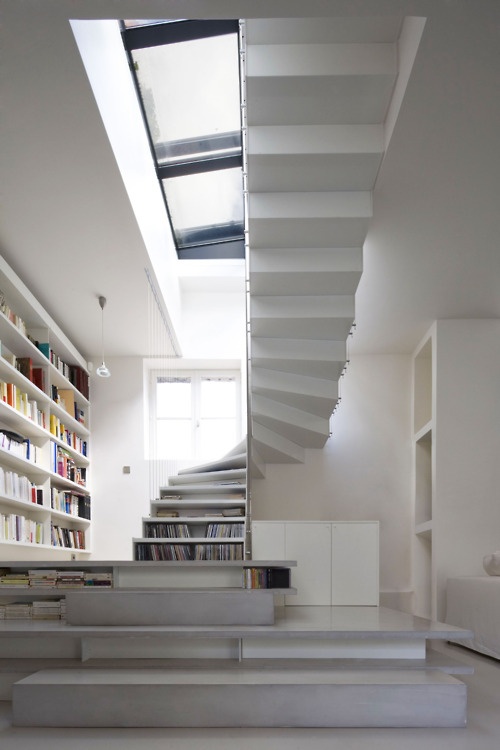
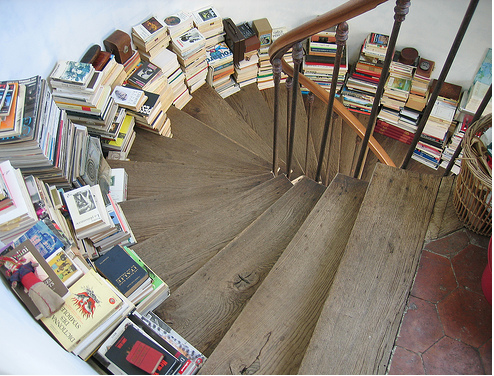
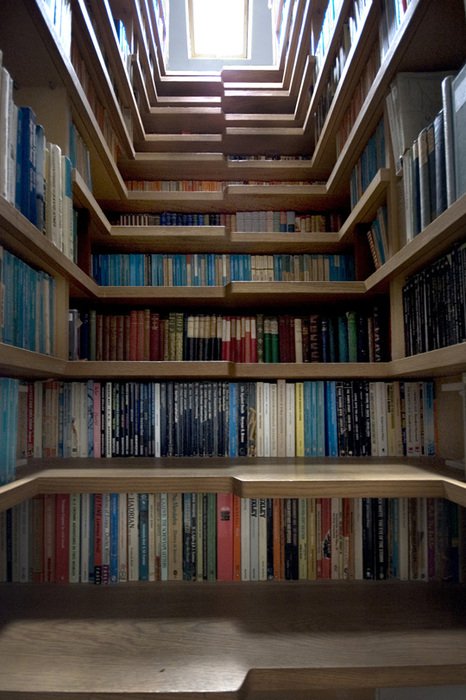
Several of the strongest pieces fuse circulation and storage. A warm wood house wraps open shelves around a stair core under a slatted ceiling and tree-filled glass—the library as heart of kitchen and dining, not a separate room. A white modern stair uses the voids under broad lower treads for horizontal stacks while a full wall of spines runs alongside. A rustic spiral piles books along every step until ascent means brushing past paper. Looking straight up another stairwell, staggered wooden treads rise toward a skylight while both side walls are continuous shelving—a vertical room made of spines.
Across these, the shared criteria are spatial efficiency and daily contact. You meet the books because you use the stairs. The risk is the same everywhere: do not block handrails, do not create trip hazards, and keep heavy volumes where vibration and foot traffic will not send them flying. Done well, the stair-library is the clearest expression of “integrated” on this page.
Sculpture, whimsy, secrets, and urban multitasking
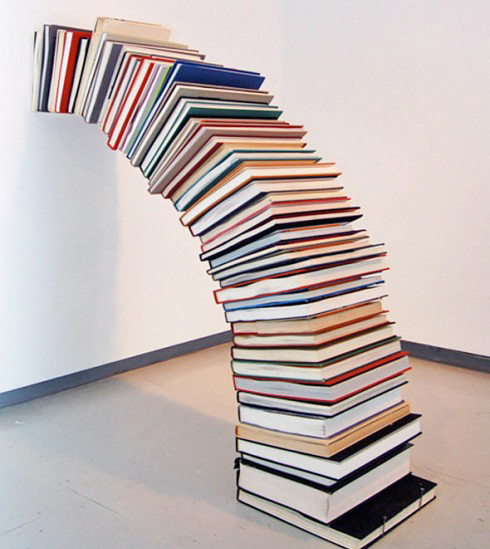
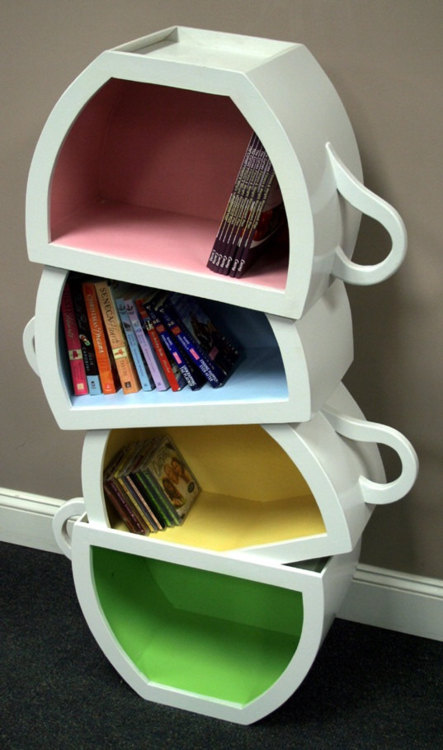
A freestanding arch made only of stacked books curving from floor to wall is gallery furniture: wonder first, retrieval second. Hidden structure almost certainly does the real work; the visible idea is that paper can become architecture. The stacked oversized teacups—white exteriors, pink, blue, yellow, and green interiors—play the opposite game: small capacity, maximum character, handles alternating like a cartoon tower. Both pieces earn “extraordinary” through silhouette.
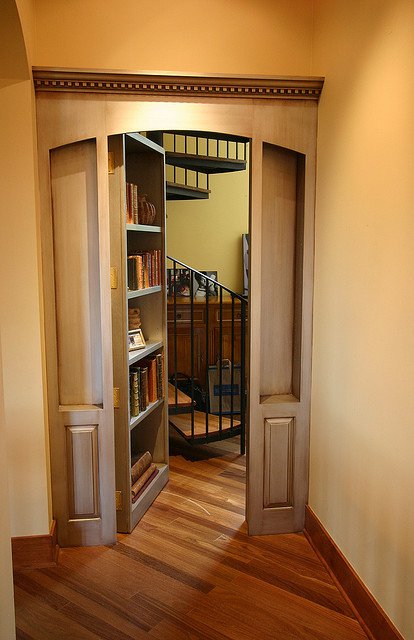
A narrow bookcase that swings open to reveal a spiral stair is the classic secret-door fantasy executed as real carpentry. Here criteria flip: the shelf must remain usable while also being a door—hinges rated for the load, books that will not avalanche when the panel moves, a frame that hides the seam. Delight is the point, but engineering is the cost of admission.
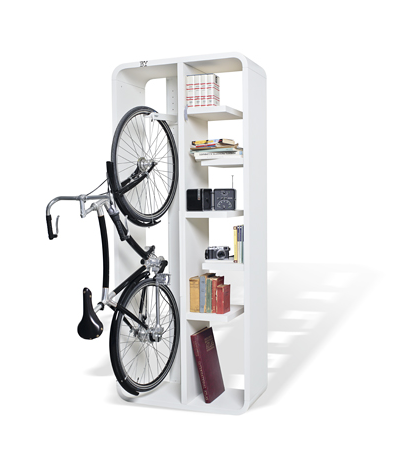
Finally, the tall white unit that parks a bicycle vertically beside six shelves of books and objects is urban pragmatism dressed as product design. Rounded frame, center divider, wheel cradles, adjustable shelves—one footprint solves two apartment problems. It may be the most transferable idea in the set for anyone who does not own a double-height library.
What to steal for a real room
- Give books a wall, a stair, or a niche—not leftover floor space alone.
- Decide whether color, subject, or frequency of use rules the arrangement.
- Light the spines; shadows kill collections.
- Leave breathing room. Packed can look intentional; stuffed looks stressed.
- If the piece is mostly sculpture, keep a boring, deep shelf elsewhere for the books you actually open.
Extraordinary bookshelf design is less about buying the weirdest unit online and more about choosing a clear relationship between paper and place. Whether your version is a quiet corridor of spines or a car on the wall, the test is the same: when you walk in, do the books feel like part of the room’s composition—or like clutter waiting for a better idea?

Comments
Continue reading
Window Seats That People Actually Sit In
Depth, cushions, storage, and light—how to build or dress a window seat so it becomes a reading spot instead of a dumping ground for laundry.

Garden Decoration Beyond Beds: Lace, Mosaiculture, and Upcycled Yard Art
From dressed topiary and floral cyclists to license-plate dragonflies and lace between trees—garden decorations that give a yard a voice.
Kitchen Design Ideas: Layout, Storage, Light, and Finishes That Work
Practical kitchen design ideas—work zones, cabinetry, lighting, and durable finishes—so inspiration translates into rooms that cook and gather well.