
Fingerprint Art by Kevin Van Aelst: Autobiography in Ridges
Connecticut photographer Kevin Van Aelst rebuilds each of his ten fingerprints from mustard, wool, snacks, and other memory-laden materials—turning biometrics into still-life self-portraiture.
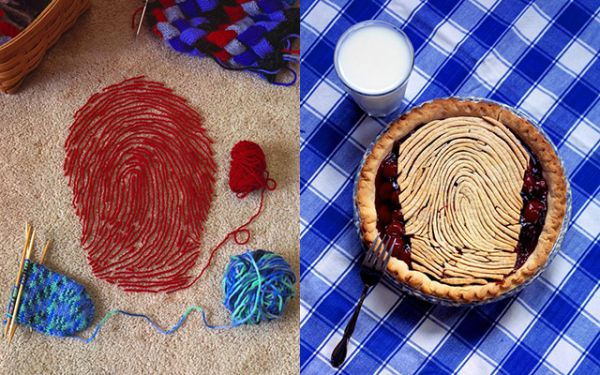
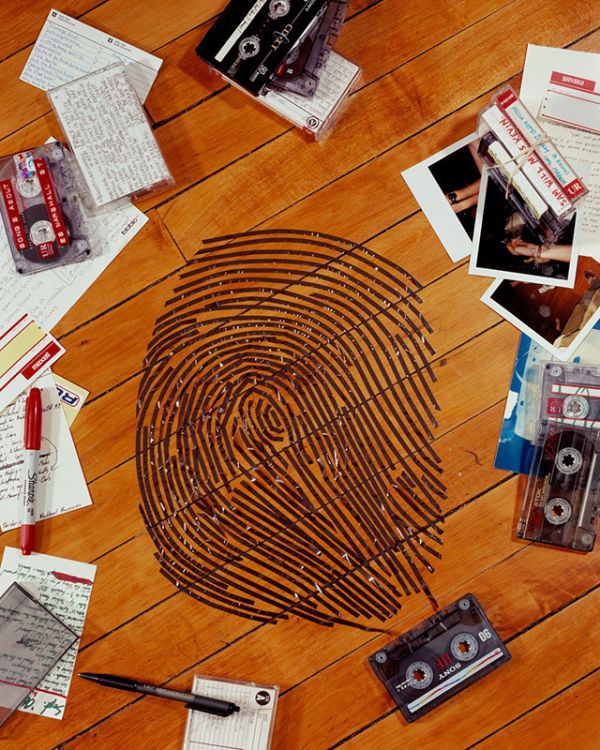
A fingerprint is usually treated as evidence: inked, scanned, filed under a case number. Photographer Kevin Van Aelst treats it as autobiography. In his Fingerprints series, each of his ten prints is rebuilt at tabletop scale from materials that belong to his own memory—food, fabric, debris, the small textures of a life—then photographed with the clarity of a scientific plate. The ridges are accurate. The staging is personal. Together they make a self-portrait that is both measurable and strangely tender.
Van Aelst, based in New Haven, Connecticut, is known for staged photographs that turn ordinary objects into diagrams of larger ideas: star charts from sweater lint, maps from broken glass, genetic charts from candy. After graduate study that leaned toward impersonal, systems-driven subject matter, a friend challenged him to make work about himself. His answer was not a conventional face-in-the-mirror portrait. It was this hybrid: the most unique graphic on his body, rebuilt from the most ordinary stuff in his past.
Objective ridges, subjective rooms
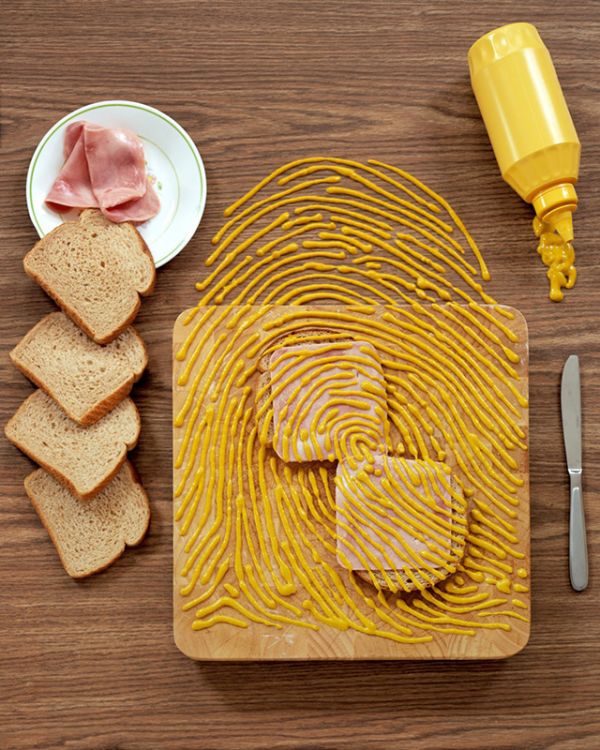
Each tableau contains a careful rendering of one specific fingerprint—loops, whorls, and deltas placed where they belong. Van Aelst has described the series as an attempt to create a portrait that holds both objective information and a subjective context for that information. The print identifies him the way a biometric would. The materials and settings identify him the way a scrapbook would.
That double reading is what keeps the work from becoming a novelty stunt. Anyone can arrange crumbs into a swirl. Fewer artists insist that the swirl match a real fingerprint and that the crumbs mean something in a personal timeline. Left ring finger, for example, has been discussed in connection with mustard and whole-wheat bread—school-lunch textures that feel distant and trivial until you admit how thoroughly early routines shape identity. Elsewhere the series has used wool, bright snack foods such as Cheetos, sugar, and other household matter. The inventory changes; the logic does not. Memory supplies the palette. The fingerprint supplies the map.
Childhood rooms haunt the compositions even when no bedroom furniture appears. A fingerprint drawn across a surface associated with play, school, or domestic mess turns the body into a place. You are not only looking at who Van Aelst is. You are looking at where certain versions of him learned to exist.
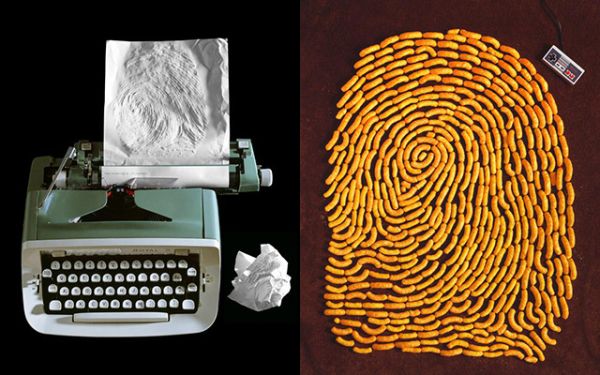
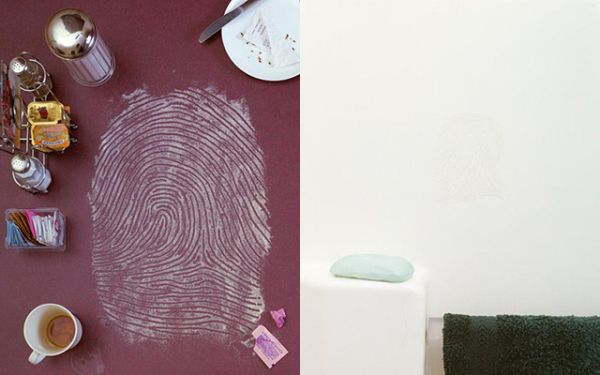
How the pictures work as photographs
These are not digital drawings of fingerprints with texture overlays. They are built scenes. Van Aelst arranges materials in real space, lights them, and photographs the result with minimal post-production beyond basic color and tone. That physical labor matters. Hair has a different line quality than mustard. Wool catches light differently than sugar. Snack dust saturates color in a way graphite never will. The camera records those differences honestly, which is why the images feel closer to still-life than to illustration—even when the overall shape is as diagrammatic as a crime-lab card.
Looking closely, you notice two competing pleasures. First, recognition: the pattern resolves into a fingerprint, and your brain enjoys the translation from mess to system. Second, inventory: once the pattern locks, your attention drifts to the props—the color of a snack, the edge of a plate, the hint of a childhood room. The series rewards both readings at once. Zoom out and you get identity as data. Zoom in and you get identity as clutter.
There is also a quiet performance of patience. Matching a real print means counting ridges, preserving deltas, resisting the urge to “improve” the pattern for graphic punch. The discipline is almost forensic. The mood is almost diary. That contradiction is the series’ signature.
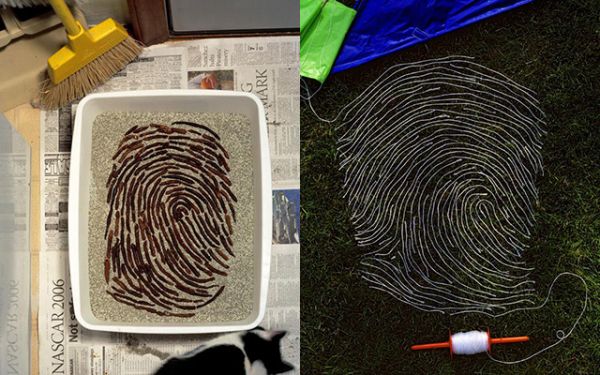
Humor without punchline fatigue
Van Aelst’s broader practice often carries a dry wit—the joke of finding cosmic order in lint or cookies. Fingerprints shares that humor, but it is quieter. Mustard ridges on bread are funny; they are also oddly solemn. The comedy comes from disproportion: something as permanent-feeling as a biometric rendered in something as perishable as lunch. The solemnity comes from the autobiographical claim. These materials are not random craft-store choices. They are stand-ins for years the artist cannot photograph directly.
That balance keeps the series from tipping into either pure cleverness or pure nostalgia. Cleverness alone would expire after the first “aha.” Nostalgia alone would become scrapbooking. Instead, each frame asks a sharper question: What if the most unique mark on your body were rebuilt from the least unique stuff you have touched?
Viewers who want only spectacle will still get spectacle. The images are meticulously weird. Viewers who want psychology will get that too—especially knowing Van Aelst studied psychology before completing an MFA in photography. The work never lectures about nature versus nurture. It simply places nature (the print) and nurture (the materials) in the same rectangle and lets them argue.
Where this sits in his body of work
Viewers who know Van Aelst from editorial illustration—especially the conceptual photographs associated with The New York Times Magazine—will recognize the same instincts here: find a familiar object, force it to carry an unfamiliar system, keep the construction legible. The fingerprint project simply turns that method inward. Instead of explaining a column’s idea, the diagram explains a person.
His artist statements about constructed photographs often insist that unconventional materials can still carry valid information. A sugar fingerprint is novel packaging for real ridge data. That claim is almost mischievous. It suggests that scientific visual culture and domestic mess are not opposites; they are different fonts for the same sentence. Fingerprints is the most intimate version of that argument because the “data” is his and the “font” is his history.
Teaching and studio practice also shadow the work. Van Aelst has taught photography in Connecticut classrooms while maintaining a commercial and fine-art career. The series feels like something you could use to teach looking: pattern recognition, still-life craft, and personal narrative without a single selfie convention.
A way to look through the set
Try a two-pass viewing for each image:
- Cover the surroundings with your hand or your attention and read only the ridge pattern. Does it feel like a real print, or only a decorative swirl?
- Uncover the scene and list five materials or props before deciding what the picture “means.”
- Ask what those materials would say about childhood if they appeared in a stranger’s photo album.
- Notice temperature and cleanliness: sticky, dusty, soft, sharp. Those sensations are part of the portrait.
- Only then connect the two: the biometric and the biography.
The exercise slows the viral reflex—the urge to caption the work as “cool fingerprint art” and move on. Coolness is there. So is something more durable: a reminder that identity is both a unique pattern you cannot choose and a pile of ordinary contacts you barely remember choosing.
If you leave the gallery or close the browser tab with one lingering question, let it be practical rather than mystical. Which five materials from your own week could rebuild your thumbprint without lying? Kevin Van Aelst’s answer, finger by finger, is already on the table: the ridges are his, the mustard and wool and sugar and snack dust are also his, and between those facts sits a portrait that never needs a face to feel complete.

Comments
Continue reading
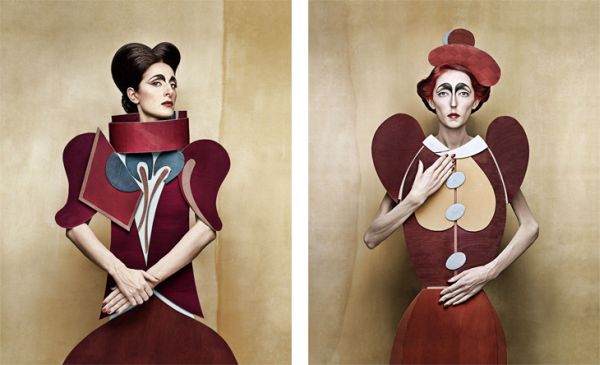
Cardboard Ladies (Dame di Cartone) by Christian Tagliavini
Christian Tagliavini’s Dame di Cartone portraits dress women in handmade cardboard couture—baroque, fifties, and cubist echoes built as craft photography.
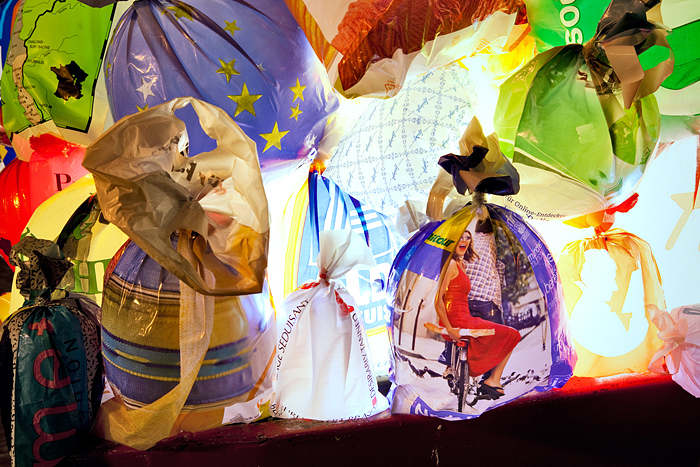
Luzinterruptus: Plastic Garbage Bags Lighting Installation in Winterthur
Luzinterruptus’s 2012 Winterthur installation Plastic Garbage Guarding the Museum—5,000+ illuminated bags left outdoors for four months.
Guy Whitby’s Celebrity Portraits Made of Computer Keys
Australian artist Guy Whitby (WorkByKnight) builds meticulous celebrity mosaics from keyboard keys, calculator pads, and phone buttons—analogue-to-digital faces in tile form.