
Guy Whitby’s Celebrity Portraits Made of Computer Keys
Australian artist Guy Whitby (WorkByKnight) builds meticulous celebrity mosaics from keyboard keys, calculator pads, and phone buttons—analogue-to-digital faces in tile form.
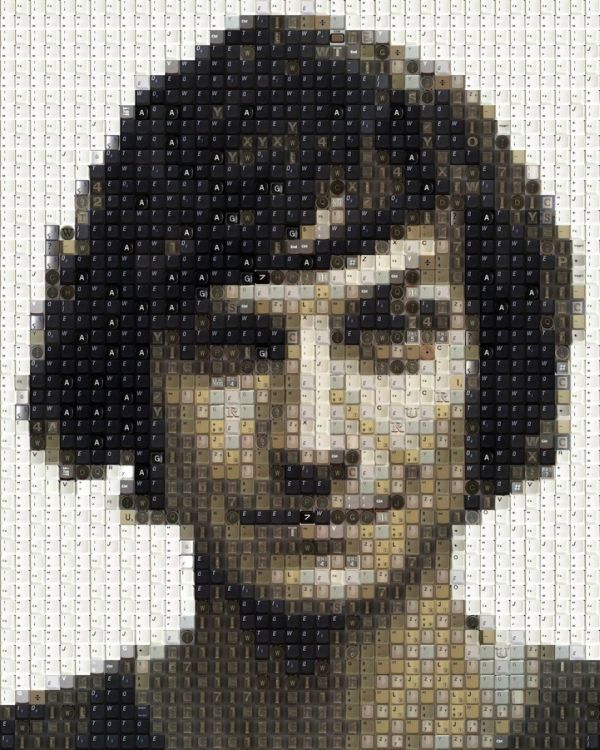
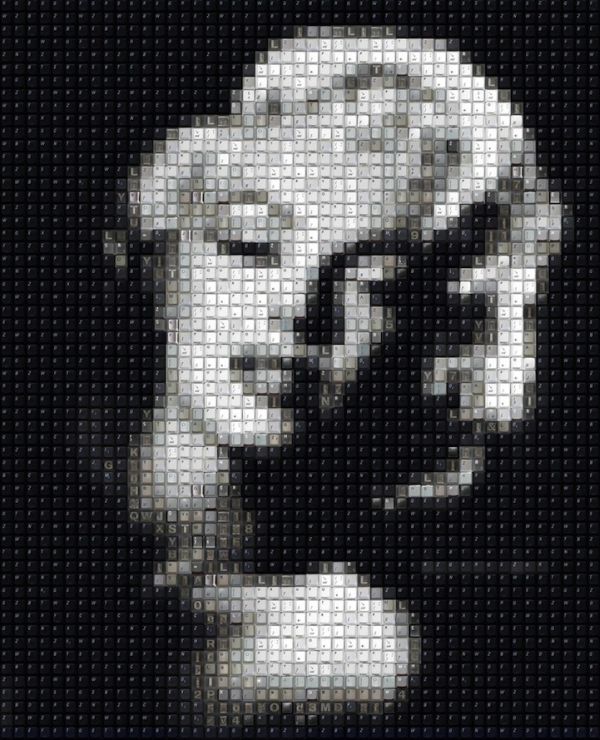
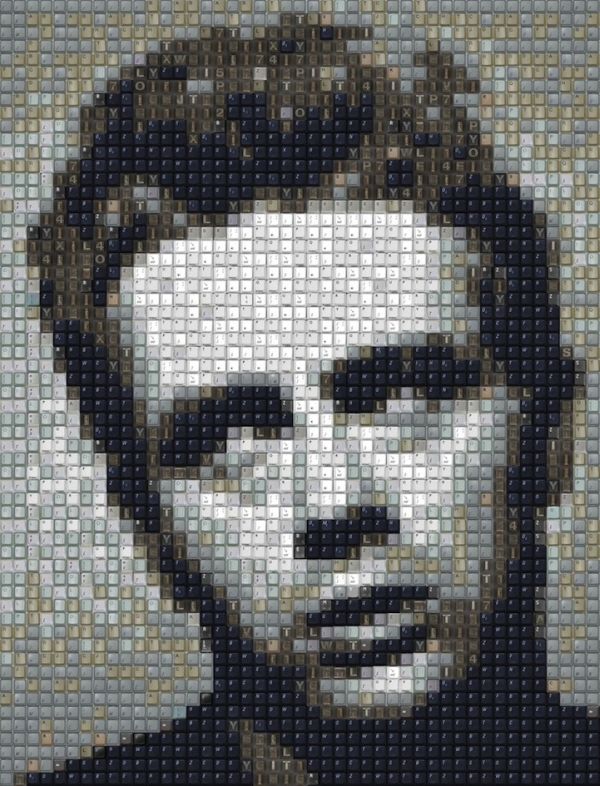
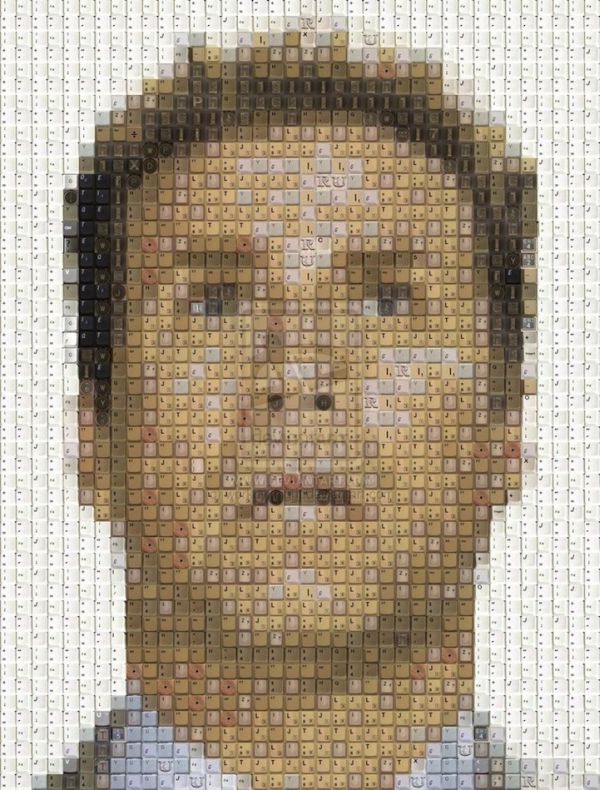
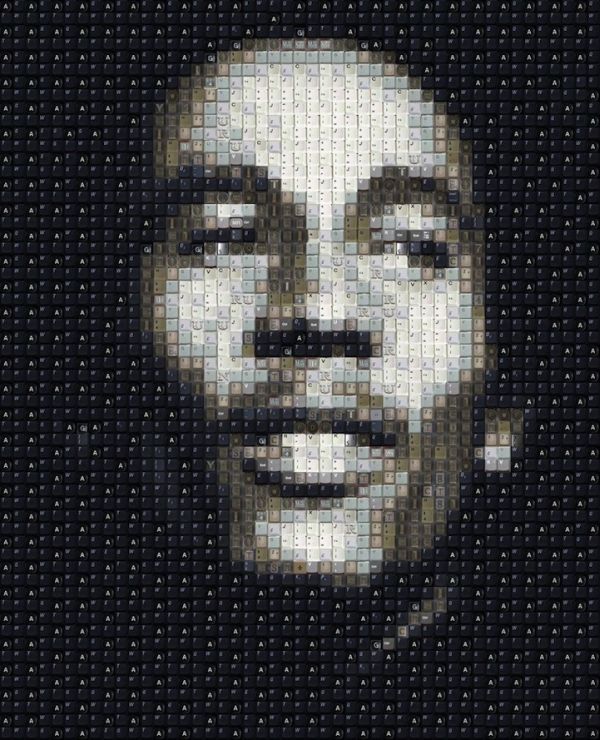
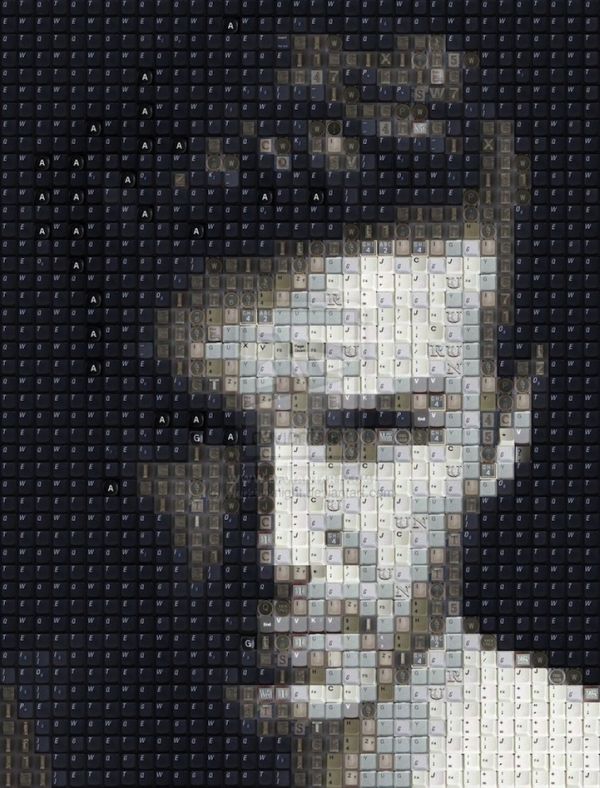
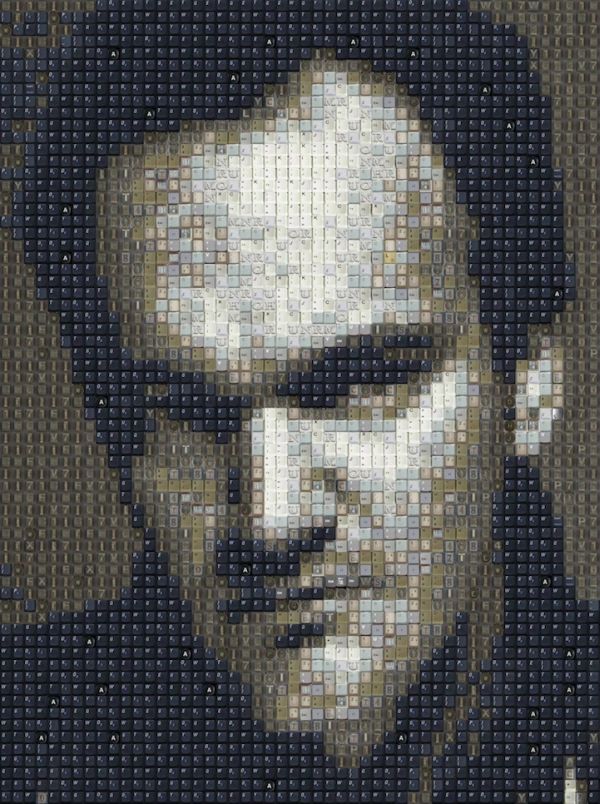
Australian artist Guy Whitby—better known as WorkByKnight, or WBK—builds celebrity faces out of the smallest pieces of our machine age: computer keys, calculator pads, phone buttons, and other lettered tiles scavenged from devices that once lived under fingertips. Up close, each portrait is a grid of worn symbols. Step back, and the grid resolves into a recognizable public figure. The trick is familiar from mosaic and pixel art, yet Whitby’s material choice gives it a cultural charge. The face is famous; the “paint” is obsolete interface.
Collecting old keys and arranging them as tiles is both craft and argument. Whitby has described a large part of his practice as a meditation on the slide from analogue to digital life. Typewriter keys and clock faces stand in for an earlier tactile world; computer and phone buttons mark the era that replaced it. Assembling those parts into portraits of people who shaped media, music, sport, and politics turns discarded hardware into biography. When these images circulated widely around 2012, they felt like perfect internet objects: instantly readable at thumbnail size, richer when enlarged, and easy to debate in a comment thread about whether they were “real mosaics” or digital composites.
How the mosaics work
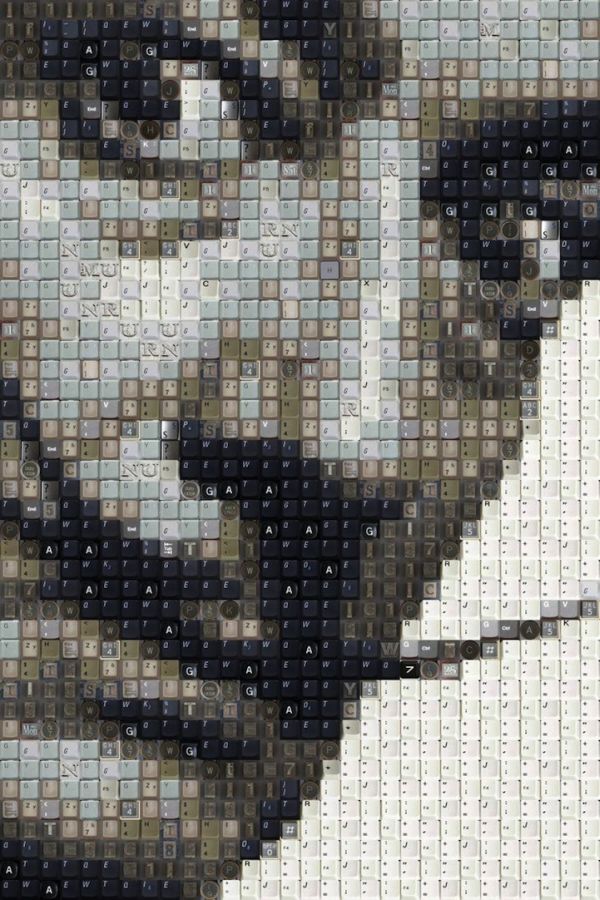
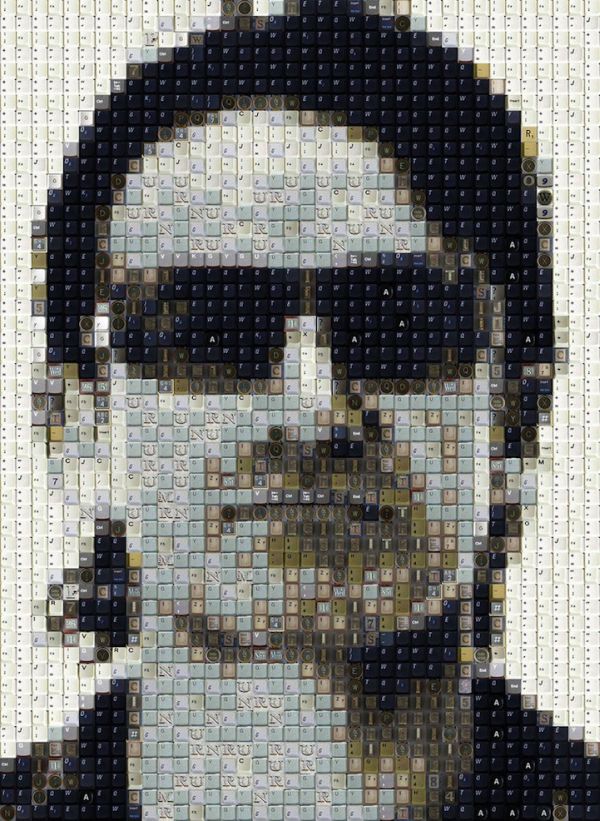
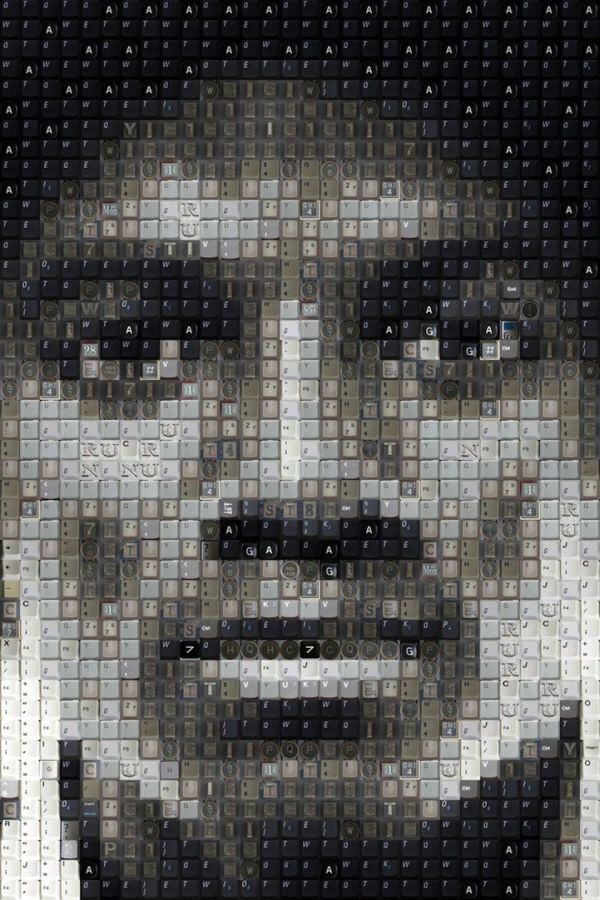
Each key functions like a pixel with personality. Unlike a uniform digital square, a real keycap carries typography, bevels, discoloration, and slightly different dimensions depending on whether it came from a laptop, a desktop board, a calculator, or a telephone. Whitby mixes those shapes so the surface never collapses into a flat wallpaper of identical tiles. Value and hue still do the heavy lifting of likeness—darker clusters for eyes and hair, lighter fields for skin highlights—but variety in the tile set keeps the eye roaming. A lazy version of the idea would tint the same square over and over. The stronger versions insist that every cell remain a miniature object with a prior life.
Many of the widely shared pieces from this period are meticulously composed digital mosaics that look handmade: images of keys arranged with photo-manipulation precision rather than glue-and-board sculptures sitting in a studio. That fact does not cancel the concept. The portraits still ask you to read mass-produced buttons as precious units of attention. Whitby has spoken about buttons as factory objects made by the hundreds of thousands, not unique until an artist forces them into a face. Meaning arrives through arrangement, the way letters become words. In that sense the work sits between collage tradition and contemporary pixel aesthetics—closer to a carefully typeset poster than to a craft-fair plaque, yet still obsessed with the romance of junk drawers and e-waste.
Resolution is part of the craft. Too few keys and the face becomes a blurry rumor. Too many tiny units and the joke of “this is a keyboard” disappears into photographic smoothness. Whitby’s successful frames hold the middle: you can still count legends and bevels, yet the celebrity remains unmistakable from across a room or a phone screen. That balance is why the series rewards zooming. The first pleasure is recognition; the second is inventory.
Subjects who changed the feed
Whitby’s gallery of faces tends toward figures who altered how culture travels: musicians, athletes, political icons, inventors, and entertainers whose images already behave like icons. Subjects associated with the series and related bodies of work include people such as Neil Armstrong, Tupac, Usain Bolt, Aung San Suu Kyi, and other twentieth- and twenty-first-century celebrities whose likenesses survive endless reproduction. Choosing those faces is strategic. A mosaic needs a strong silhouette and familiar landmarks—eyes, jaw, distinctive hair—or the keys remain noise. Public figures who already live as posters give the artist a head start; the keys then complicate that familiarity instead of fighting for basic recognition.
There is irony in building a pop star from QWERTY fragments. Celebrity photography usually polishes skin into continuous tone. Whitby breaks the face into industrial crumbs. The portrait still flatters recognition, but it refuses glossy smoothness. You are reminded that fame itself is assembled from fragments: interviews, album covers, news stills, and the devices we used to circulate them. A keyboard is a fitting medium for that reminder because it is literally how many of those stories were typed, shared, and argued over.
Related strands of Whitby’s practice push the same logic into other found vocabularies—granny-square textiles assembled into famous compositions, or actual sewing buttons forming classical and pop references. Those experiments clarify the keyboard portraits: the celebrity face is only half the subject. The other half is the category of object we throw away without ceremony. Keys, buttons, and craft scraps become a recurring cast of extras promoted to starring roles.
Analogue memory, digital method
Whitby has written about growing up before computers and phones felt mandatory, then watching touchscreens make physical buttons feel antique. Pushing a key, he suggests, was more tangible than brushing glass. That nostalgia could turn soft; instead his work stays slightly cool. Buttons are relics and also evidence of mass production. In statements accompanying the work he has linked discarded devices to mortality—the way a once-treasured Walkman becomes irrelevant, and people fear the same fate. The mosaics hold that unease without becoming sermons. You can enjoy them as clever portraits and still feel the chill of planned obsolescence under the cleverness.
Designboom and other art blogs covering the “analogue to digital” strand emphasized how Whitby mixes eras inside a single face: analogue type parts beside calculator pads, clock fragments beside phone buttons. That mixture is more than texture. It proposes that cultural transition is not a clean switch. We carry old interfaces in memory even while we swipe new ones. A portrait made of both becomes a timeline compressed into a head-and-shoulders crop.
Looking at the set as a gallery, try two distances. First, identify the person. Second, invent a story about the keys: which look like they survived an office, which look like calculator leftovers, which still show bold sans-serif legends. The portraits reward that double vision. They are likenesses and inventories at once. If a particular face resists you, lean closer until letters and numbers dissolve the celebrity into hardware—then step back until the hardware becomes a person again. That oscillation is the piece performing.
What makers can borrow
If you make collage or pixel work yourself, Whitby’s series is a useful constraint study. Limit your palette to a found vocabulary. Force every “brushstroke” to be an object with prior use. Keep enough contrast for recognition at thumbnail size, because these images lived—and still live—as web gallery pieces that must survive compression. Meticulous alignment matters; crooked grids read as accidents, while disciplined rows let the face emerge cleanly. Choose subjects whose public images already have high contrast and distinctive shapes. And decide early whether your work will be physical assemblage, digital mosaic, or a hybrid—each choice changes how viewers judge “authenticity,” but none of them excuses weak value structure.
Guy Whitby’s computer-key celebrity portraits remain popular because they translate a familiar worry—our tools age faster than our icons—into something you can enjoy without a manifesto. The keys are humble. The faces are not. Between those two facts, the mosaic does its quiet work: it makes you notice both the person and the plastic history underwriting the picture. Save one image that stops you longest, then ask what the tiles are made of before you ask who is looking back.

Comments
Continue reading
Koen Hauser's Modische Atlas der Anatomie: Fashion Portraits as Elegant Dissection
Dutch artist Koen Hauser's 2000 series Modische Atlas der Anatomie merges fashion photography with anatomical curiosity through early digital manipulation—still unsettling, still elegant.
Fingerprint Art by Kevin Van Aelst: Autobiography in Ridges
Connecticut photographer Kevin Van Aelst rebuilds each of his ten fingerprints from mustard, wool, snacks, and other memory-laden materials—turning biometrics into still-life self-portraiture.
Cardboard Ladies (Dame di Cartone) by Christian Tagliavini
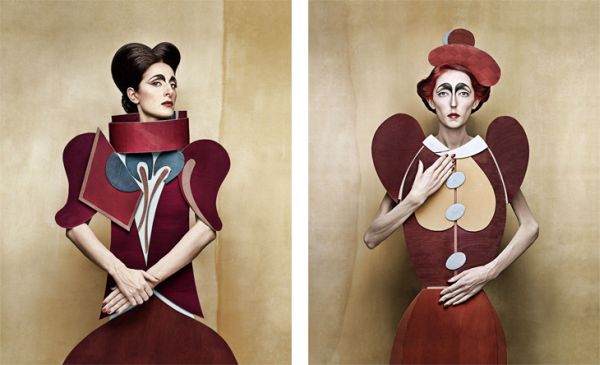
Christian Tagliavini’s Dame di Cartone portraits dress women in handmade cardboard couture—baroque, fifties, and cubist echoes built as craft photography.