
1906 and Today: Shawn Clover’s San Francisco Earthquake Composites
Shawn Clover blends archival photos of the 1906 San Francisco earthquake and fire with matched modern views—precise then-and-now images that honor disaster memory without turning it into spectacle.
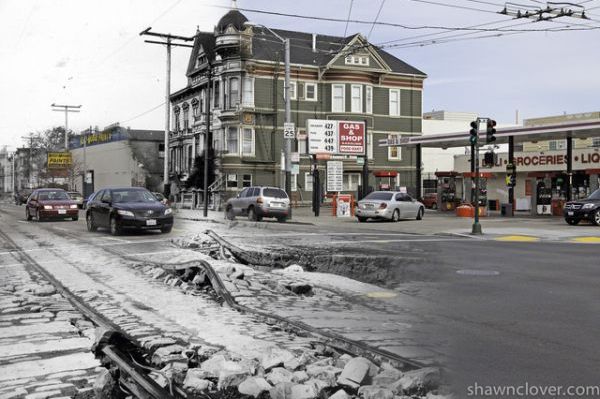
On the morning of April 18, 1906, a massive earthquake struck the San Francisco Bay Area. The shaking lasted less than a minute for many who felt it, but the fires that followed burned for days. Roughly three thousand people died. More than half the city’s population was left homeless. Neighborhoods of wood and brick collapsed or burned; landmarks stood as shells; ordinary streets became corridors of rubble, smoke, and makeshift camps.
That disaster is not a metaphor first. It is a historical event with names, addresses, and grief attached. Any “what if it happened today” conversation that treats the quake as a special-effects prompt has already lost the plot. The better question is quieter: how do we keep the scale of 1906 visible in a city that has since rebuilt, densified, and learned—imperfectly—to live with seismic risk?
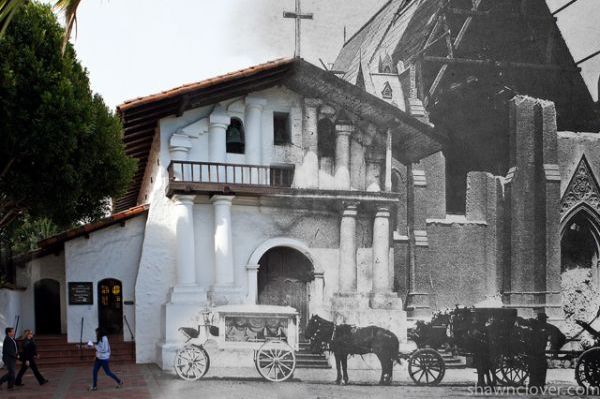
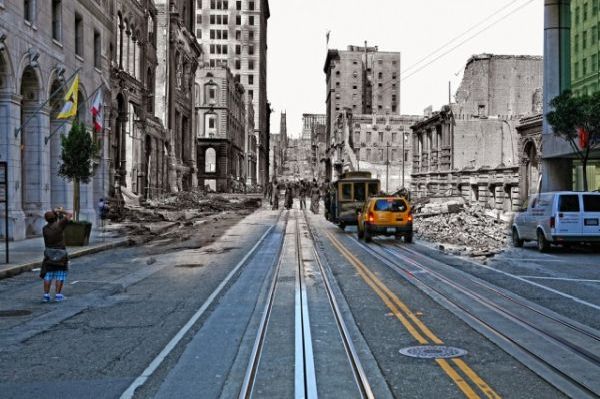
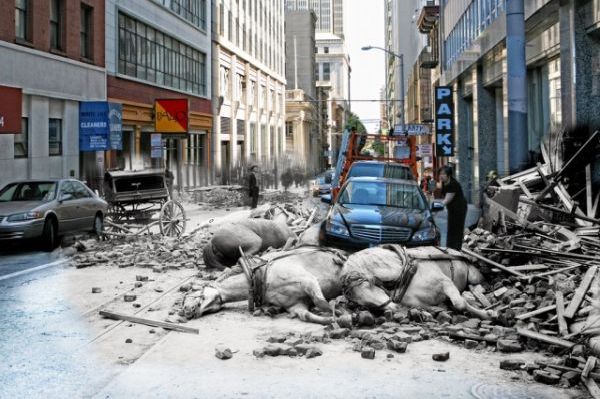
Photographer Shawn Clover answered that question with craft rather than speculation. In his composite series often discussed as “1906 + Today” or related “Fade to 1906” work, he blends archival photographs of the ruined city with carefully matched modern views of the same locations. Horses and rubble share pavement with cars and tourists. A burned hotel facade overlaps a living street. The effect is not fantasy catastrophe; it is memory made spatially precise.
What 1906 actually did
The earthquake’s magnitude is commonly estimated near 7.9. Damage stretched far beyond San Francisco, but the city’s concentration of people, wooden buildings, and broken water mains turned a seismic event into an urban firestorm. Contemporary accounts describe survivors searching for family, soldiers and civilians trying to contain flames, and whole districts erased in a few days. Insurance fights, relief camps, and debates about rebuilding followed for years.
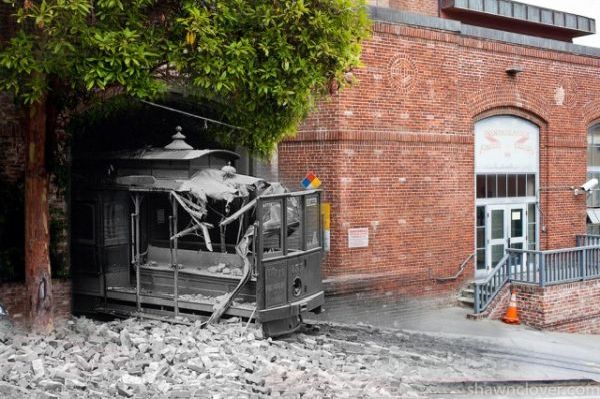
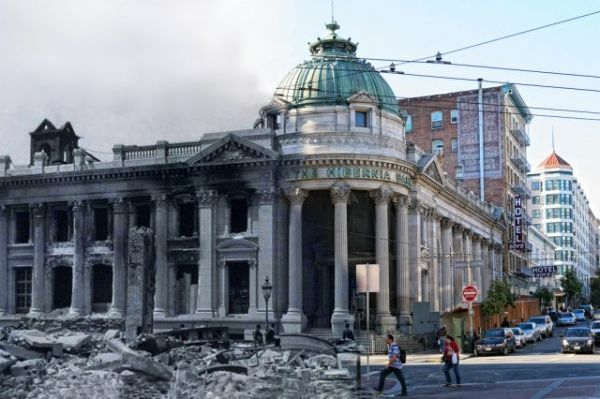
Photographs from 1906 are among the most important primary documents of the disaster. Cameras recorded buckled streets, cable-car barns half swallowed by debris, bank buildings gutted by fire, and hillsides of tents where residents waited. Those images were already “then” pictures when they were taken. A century later they risk becoming picturesque ruins—beautiful in grayscale, easy to aestheticize. Clover’s project pushes against that comfort by forcing the old damage to occupy the same visual field as today’s ordinary life.
Respectful looking starts with that context. The people in the archival frames were not extras. Animals in the street were not set dressing. When a modern composite shows a pedestrian crossing toward rubble that no longer exists, the point is continuity of place, not entertainment value in suffering.
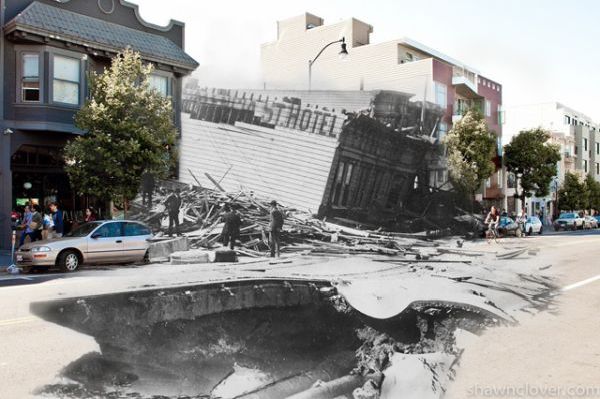
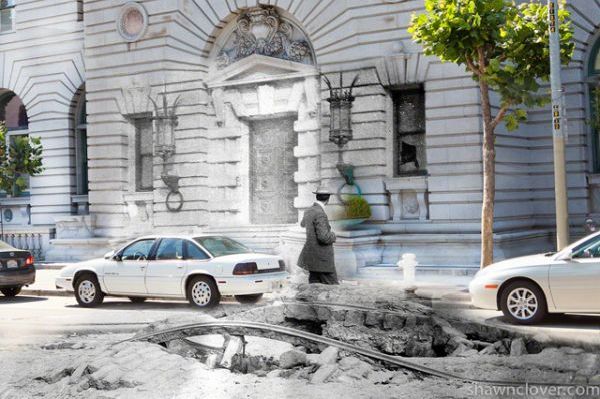
How the composites were made
Clover has explained that he grew frustrated with sloppy then-and-now comparisons—pairs of photos that shared a neighborhood name but not a true viewpoint. His method was slower. He gathered publicly available 1906 images, mapped likely camera positions, and walked the city to match perspective, focal length, camera height, and even the sun’s angle when possible. Many attempts failed: a modern building blocked the old sightline; a tree filled the frame; the original photographer had stood on rubble that no longer exists.
At usable sites he shot dozens of frames, then layered past and present in Photoshop with meticulous alignment. Tilt-shift lenses and perspective corrections helped approximate the lens-shifted plates common in early photography, when keeping buildings from leaning was standard craft. The resulting blends are not seamless “impossible photos.” They are transparent enough that you can still tell two times are talking to each other.
That honesty is part of their ethics. A fully fake disaster render of modern San Francisco collapsing would invite spectacle. Clover’s images keep the 1906 damage as historical evidence and the modern layer as ordinary continuity—people walking, cars moving, cable cars running—so the viewer feels juxtaposition rather than invented gore.
What “if it happened today” can responsibly mean
The page title invites a counterfactual. Science and planning already answer parts of it without needing horror fiction. A similar magnitude event on the San Andreas or a major Bay Area fault would still be catastrophic: deaths, injuries, fires, broken infrastructure, disrupted hospitals, long recovery. Building codes, seismic retrofits, early-warning systems, and emergency planning are real improvements since 1906. Soft-story ordinances, base isolation in critical buildings, and public drills exist because the city remembers.
None of that makes a major quake “safe.” Density is higher. Dependence on power, transit, water, and digital networks is deeper. Land values and inequality shape who can prepare and who recovers first. A thoughtful today-comparison holds two truths at once: engineering and preparedness have advanced; vulnerability has changed shape rather than vanished.
Clover’s own remarks about the work often land in that register. Looking at a blended frame—someone entering a modern car where animals once lay in the street—he has described the recognition that disaster happened here and can happen again. The composites are memento mori for a city, not disaster porn. They ask for attention, not adrenaline.
How to look at these images
A useful way through the gallery:
- Name the modern layer first. What is ordinary here—traffic, tourism, a standing landmark?
- Find the 1906 evidence. Rubble lines, burned interiors, buckled pavement, ruined interiors behind intact shells.
- Notice surviving structures. Some buildings in the archival photos were already famous for enduring fire or quake; their endurance is part of local memory.
- Resist aestheticizing suffering. If a detail feels “cool,” ask what it cost the people who lived it.
- Carry the question forward. What would fail on this block now: water, power, housing, transit, medical access?
Locations that circulate with the series—Market Street near the Hibernia Bank, California Street with cable cars and Old St. Mary’s, the Fairmont’s shell, Van Ness buckling, streets near the U.S. Mint—matter because they are still navigable places. The map is continuous. Only the debris layer flickers in and out of view.
Photography as civic memory
Then-and-now projects can become tourism. Clover’s best frames avoid that trap by making the past interrupt the present instead of sitting politely beside it. You cannot glance once and file the disaster as finished. The modern city keeps moving through the old wound.
That approach also models better public history online. Short blog posts of 2012 often reduced the work to a viral gallery credit. The images deserve the slower reading: research into camera positions, patience on street corners, and an ethic of precision. Matching a viewpoint is a form of respect. It says the original photographers stood somewhere real, and the people they photographed occupied a real disaster.
If you live in or visit San Francisco, the composites can change how you walk. A hotel lobby, a cable-car turn, a bank corner—any of them may sit inside a photographed aftermath. Remembering does not require living in fear. It does require refusing amnesia. Seismic culture at its best is practical: retrofit, kits, neighborhood plans, honest talk about soft stories and landfill soils. Art can support that culture when it restores scale without turning death into a thrill.
Clover’s blends do not predict the next earthquake’s death toll or draw a cinematic skyline of collapse. They do something harder and more useful. They hold 1906 and the living city in one frame long enough for a viewer to feel the distance—and the unfinished responsibility—between them.

Comments
Continue reading

Still-Life Photography at Home with One Window
A table, north or side light, and a handful of objects—how to shoot still lifes in a small room without a studio, softboxes, or a prop closet.

Dramatic Photo Art by Sukron Ma’mun (Ipoenk Graphic)
Cirebon, Indonesia photographer Sukron Ma’mun uses theatrical natural light to frame village life, play, and place in lyrical photo art.

Bird’s-Eye Views: Florian Beaudenon’s Instant Life
Paris photographer Florian Beaudenon’s Instant Life series captures people in their rooms from above—intimate, collaborative overhead portraits of everyday joy.