
Finn Hopson’s The End of the Pier: Brighton’s West Pier in Decline
Brighton photographer Finn Hopson’s long project documenting the West Pier’s slow disappearance into the sea—weather, iron, and a landmark’s last chapters.
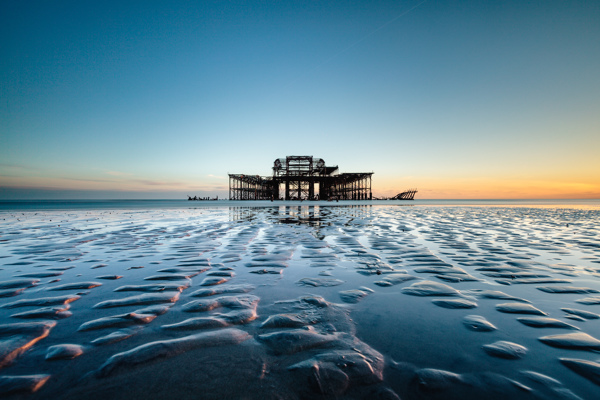
Brighton’s West Pier has been dying in public for decades—closed to walkers, cut off from land, burned, stormed, and slowly claimed by the Channel. Brighton photographer Finn Hopson began photographing that demise in 2012 under the project title The End of the Pier. The work was never framed as a single dramatic “ruin afternoon.” It was a return practice: go back to the same skeletal landmark as weather, tide, and structural loss kept rewriting what remained above the water.
As Hopson described the project in the mid-2010s, it carried a clear end condition. He would keep making pictures while there was still a pier to photograph—until the iron and timber finally disappeared into the sea. That patience changes how you read the gallery. These frames are not isolated pretty wrecks collected on a lucky sunset. They are chapters in a slow vanishing, made by someone who lives with the silhouette every week rather than discovering it on holiday.
A landmark already past usefulness
The West Pier closed in the 1970s after being declared unsafe. Fires in the early 2000s and hard winter storms stripped it further, leaving the broken outline that still defines stretches of Brighton’s seascape. Locals and visitors know that outline even when they cannot walk it. Hopson’s photographs treat the familiarity as raw material. He does not need to explain Victorian pleasure architecture from first principles. He needs to show what salt, fire scars, and time do to a public memory once the public can no longer stand on the boards.
That history keeps the series from becoming generic coastal drama. The subject is specific: this pier, this town, this long goodbye. Hopson, rooted in Brighton and later known widely for South Downs and sea-swimming work as well, photographs a landmark he shares with neighbors. Proximity shows in the work’s calm. There is little tourist astonishment. There is attention—sometimes from the shore, sometimes in conversations with light that only repeats if you return.
Ruin sites attract cameras because decay can look like ready-made symbolism. Hopson’s better pictures resist turning the West Pier into a mood board. They stay descriptive: metal, gap, waterline, sky. Melancholy arrives because the facts are melancholy, not because a filter insisted.
Weather as co-author
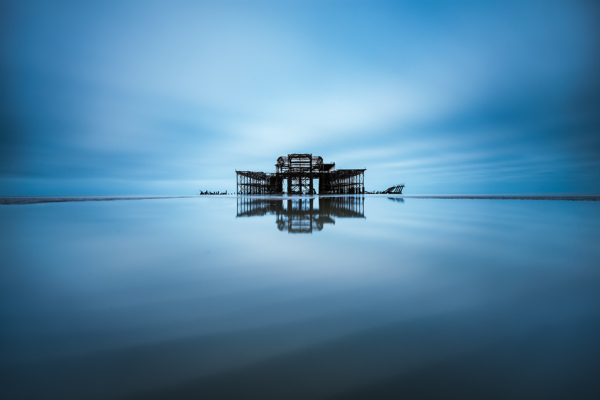
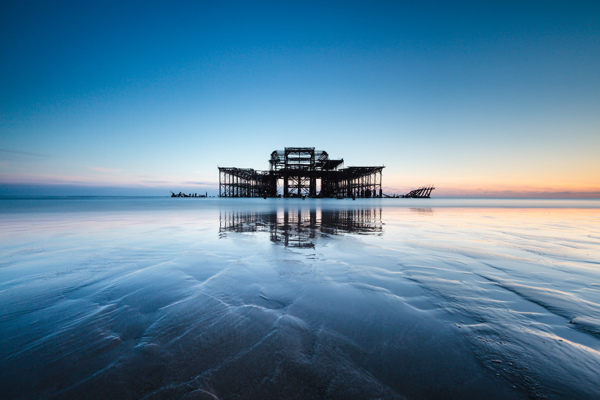
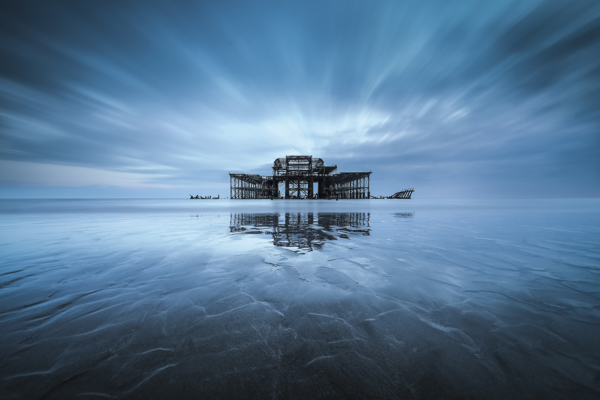
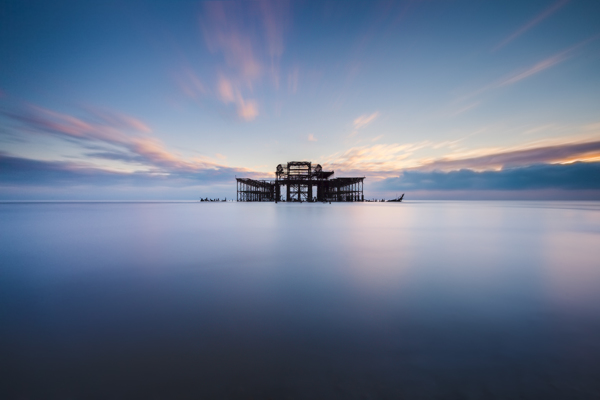
Look across the set and the pier stays recognizable while the air around it changes. Hard light sharpens every corroded rib. Soft haze turns the structure into a gray calligraphy stroke on the water. Low sun can gild rust until decay looks almost ceremonial. Storm light flattens color and raises the sea until the pier seems briefly threatened again—though the real threat is cumulative, not theatrical. One bad night matters; years of nights matter more.
Hopson’s strength is letting weather remain weather. He does not appear to chase only the most extreme postcard sunset. Mid tones, pale skies, and quiet horizons appear often enough to prove the project is about duration. A single heroic sky sells a print in a gift shop. A sequence of ordinary seas sells the idea of watching something end in public, slowly, while buses still run along the front and people still eat chips nearby.
Seasonal return also means accepting repetition risk. The pier will look “the same” until it suddenly does not—another section gone, another angle opened, another storm’s subtraction. Longitudinal projects live in that almost-sameness. The photographer’s job is to stay interested anyway.
Iron, absence, and the line of the sea
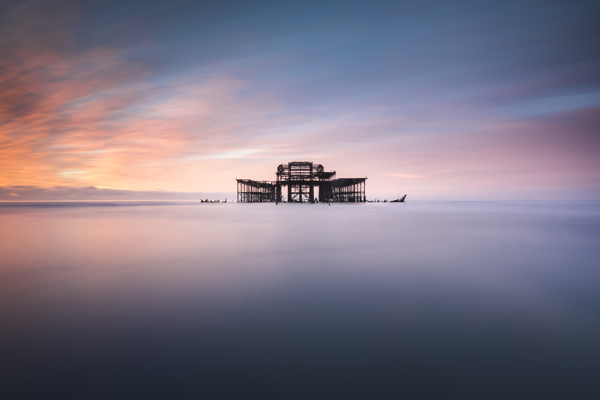
Compositionally, many frames hinge on a simple tension: vertical and diagonal remnants of architecture against the long horizontal of water and shore. Where decking and pavilions once made a busy pleasure machine, the photographs often give you open air punched by remaining uprights. Negative space is not emptiness for style points. It is documentary fact—the missing middle of a pier that no longer bridges land to pavilion in any usable way.
Birds enter the way they enter any Brighton seafront day, small against iron, sometimes dense in murmuration seasons that later became another of Hopson’s fascinations from the water. People, when present at frame edges or implied by promenade life beyond the wreck, remind you the city continues. The pier’s ending is not the town’s ending. That imbalance—living city, dying landmark—gives the series its emotional temperature without speeches.
Detail frames matter as much as wide silhouettes. Close to the metal, you read texture: corrosion patterns, broken geometry, the way paint and rust negotiate. Pull back, and those details collapse into a dark mark on a wide Channel. Hopson’s set uses both distances so the pier remains both object and symbol without floating free of either.
A project measured in returns
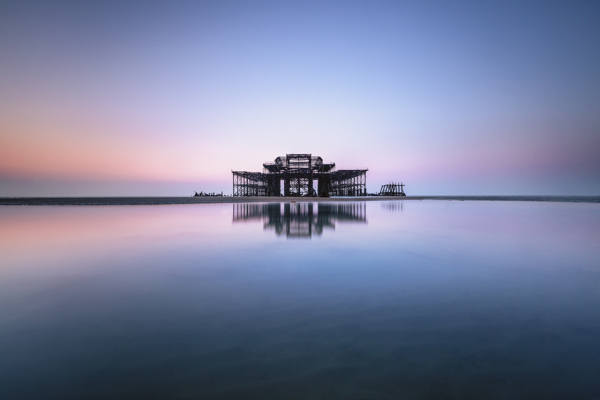
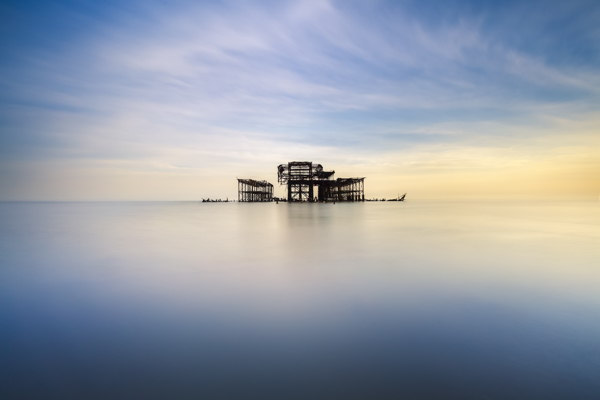
Long projects ask for humility. Each visit risks making the picture you already made. Hopson’s answer, visible in the variety of angles and atmospheres here, is to treat the pier as a changing instrument rather than a fixed icon. Move closer to corroded detail; pull back until the structure is calligraphy; catch reflections; catch mist; catch a harder graphic skyline. The subject stays. The photograph’s job keeps shifting.
That method aligns with how Brighton residents actually experience the West Pier: not as a one-time spectacle, but as a constant companion on walks, bus rides, and winter storms—always there, always a little less. A project that ends only when the pier is gone takes that local relationship seriously. It also refuses the false urgency of “last chance” tourism copy. The ending is real; it simply refuses to arrive on a marketing schedule.
For viewers outside Brighton, the series still works because slow architectural death is readable anywhere ports and pleasure buildings meet hard weather. You do not need every local date memorized. You need enough frames to feel subtraction.
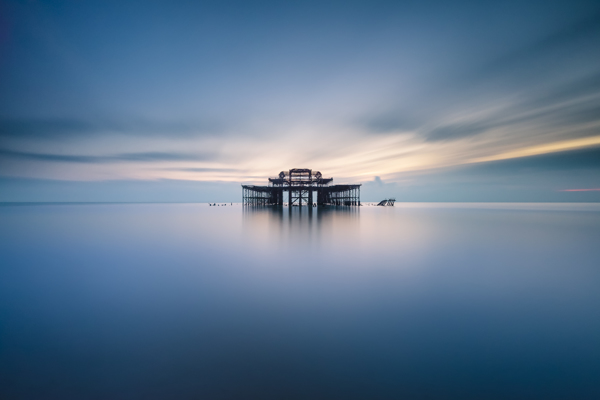
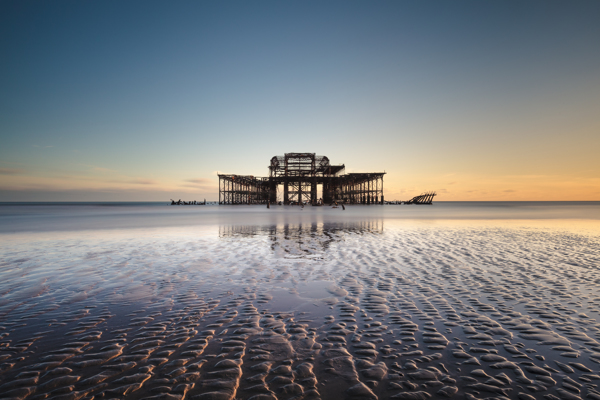
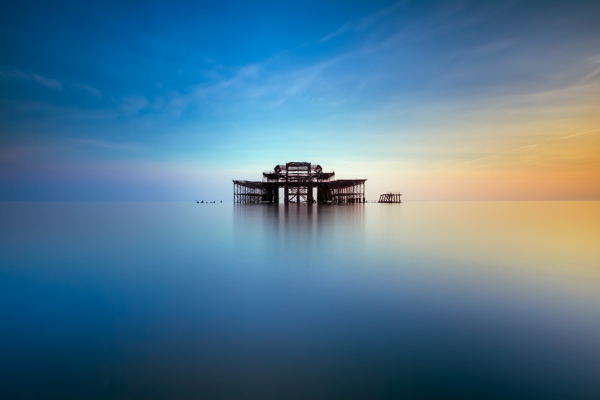
Looking without turning ruin into decoration
Ruin photography slides easily into aestheticizing loss until history becomes wallpaper. Hopson’s stronger frames push back by staying factual about what holds and what has already been claimed. Beauty appears—coastal light is generous—but it arrives as a byproduct of attention. Viewers can feel ache without being instructed to pose beside it for a caption.
If you work through the images slowly, ask a practical question at each one: what is still standing, and what has the sea already taken? That question keeps the gallery honest. It also explains why a Brighton photographer would commit years to a structure everyone already “knows” from the promenade. Knowing an outline is not the same as witnessing its last grammar of beams and gaps.
Finn Hopson’s The End of the Pier is a local chronicle with a built-in last page. Until that page arrives, the photographs keep the West Pier visible as something unfinished—still present enough to be seen, already gone enough to hurt. Stand with the set as you would stand on the seafront: return, look again, notice what changed since last time.

Comments
Continue reading

Still-Life Photography at Home with One Window
A table, north or side light, and a handful of objects—how to shoot still lifes in a small room without a studio, softboxes, or a prop closet.
Dramatic Photo Art by Sukron Ma’mun (Ipoenk Graphic)
Cirebon, Indonesia photographer Sukron Ma’mun uses theatrical natural light to frame village life, play, and place in lyrical photo art.

Bird’s-Eye Views: Florian Beaudenon’s Instant Life
Paris photographer Florian Beaudenon’s Instant Life series captures people in their rooms from above—intimate, collaborative overhead portraits of everyday joy.